
38 moments
Birth at Shaoshanchong
· Shaoshanchong, Shaoshan, Hunan, China
Mao was born in the rural Hunan village of Shaoshanchong. Coordinates identify the Shaoshanchong birthplace area.
Higher primary school at Dongshan
· Dongshan Higher Primary School, Dongshan, Xiangxiang, Hunan, China
As a teenager, Mao moved from Shaoshan to study at Dongshan Higher Primary School. The source gives Mao's age rather than a calendar date; 1909 is calculated from his December 1893 birth.
Rebel army service
· Changsha, Hunan, China
During the Xinhai Revolution, Mao served as a private soldier with the rebel army in Changsha. The cited passage establishes army service amid the Changsha uprising but does not give a more exact enlistment date.
Secondary schooling and revolutionary enlistment
· Changsha, Hunan, China
Mao began secondary school in Changsha and subsequently joined the rebel army during the Xinhai Revolution.
Studies in Changsha
· Changsha, Hunan, China
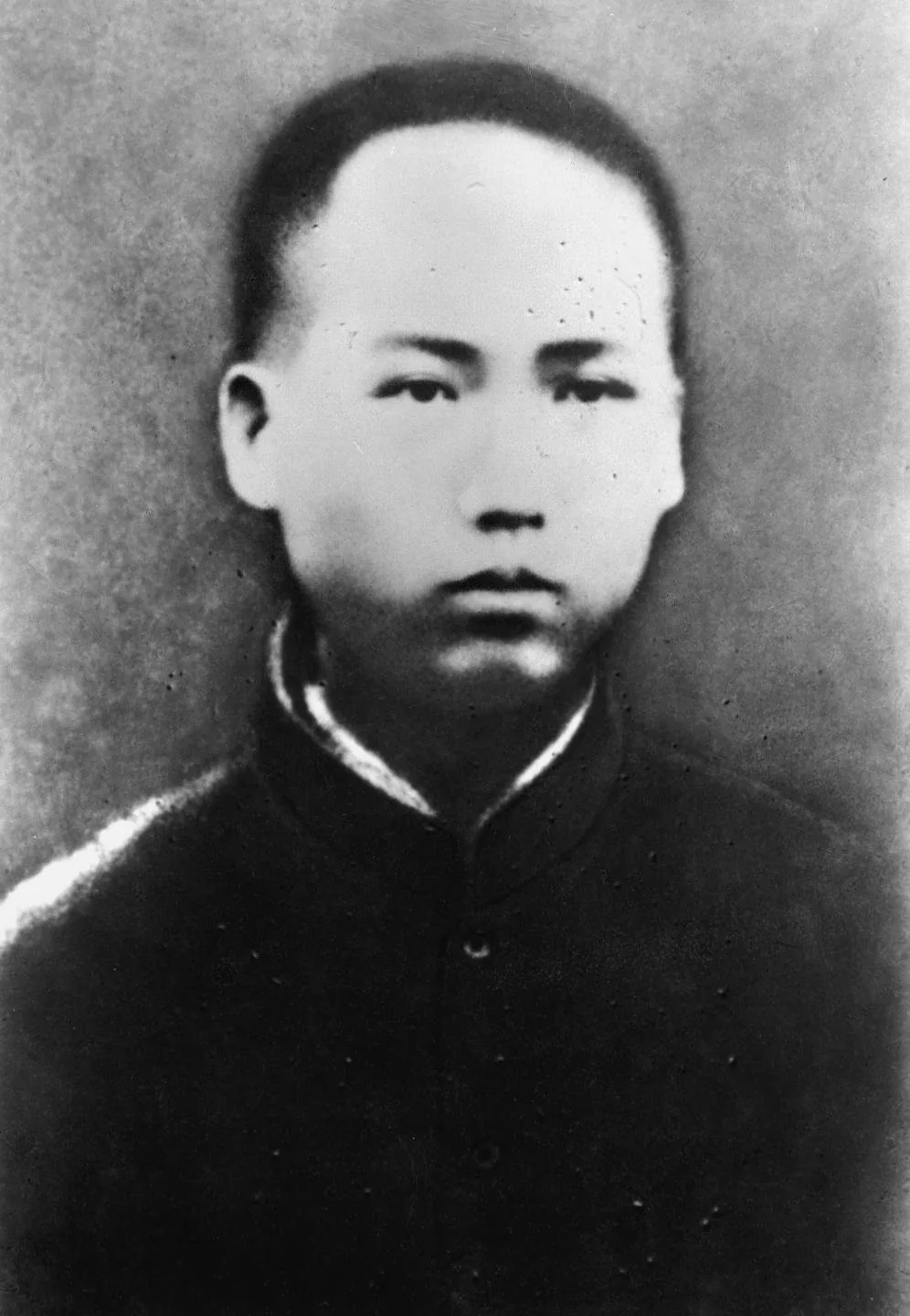
Wikimedia Commons · Public domain · file After leaving the army, Mao resumed education and spent substantial time studying in Changsha. The passage is in the 1912–1919 section; 1912 is used as the maximum defensible starting-year precision.
Teaching and organizing in Changsha
· Changsha, Hunan, China
Mao taught history at Xiuye Primary School while organizing protests against Hunan's governor. The source situates this activity in 1919.
Return to Beijing
· Beijing, China
Threatened after organizing a Hunan general strike, Mao returned to Beijing and visited his dying teacher Yang Changji.
Travel through Tianjin, Jinan, and Qufu
· Tianjin, China
Mao travelled through Tianjin, Jinan, and Qufu before relocating to Shanghai. The source supplies a sequence of visits but no individual dates or venues; Tianjin is used as the card's representative first stop.
Work and political contacts in Shanghai
· Shanghai, China
In Shanghai, Mao worked as a laundryman and met Chen Duxiu, whose Marxism deeply impressed him.
First CCP Congress
· Xintiandi, Shanghai, China
Mao was among the thirteen delegates at the first session of the Chinese Communist Party's National Congress in Shanghai. Coordinates identify the Xintiandi site associated with the first congress.
First CCP Congress relocation
· South Lake, Jiaxing, Zhejiang, China
After police attention disrupted the Shanghai congress, Mao and the other delegates moved to a boat on South Lake near Jiaxing. The move occurred during the July 1921 congress; the source does not date the transfer more precisely.
CCP secretary in Changsha
· Changsha, Hunan, China
Mao served as CCP secretary for Hunan while stationed in Changsha and founded the Self-Study University there.
Residence after the Third CCP Congress
· Shanghai, China
After the Third National Congress of the CCP, Mao took up residence in Shanghai as a member of the Party Committee.
First KMT Congress
· Guangzhou, Guangdong, China
Mao attended the First KMT Congress in Guangzhou, where he became an alternate member of the Central Executive Committee. The source specifies only early 1924.
Return to Shaoshan
· Shaoshan, Hunan, China
Mao returned to Shaoshan, where growing rural unrest reinforced his focus on the revolutionary potential of the peasantry. The source gives late 1924 but not a month.
Flight to Guangzhou
· Guangzhou, Guangdong, China
Mao fled to Guangzhou after regional authorities focused on his revolutionary activity. Winter spans 1925–1926; the card uses the explicitly stated starting year.
Peasant Movement Training Institute
· Peasant Movement Training Institute, Guangzhou, Guangdong, China
Mao directed the sixth term of the KMT Peasant Movement Training Institute in Guangzhou, training political cadres.
Third KMT Central Executive Committee Plenum
· Wuhan, Hubei, China
Mao appeared at the Third Plenum in Wuhan and participated actively in discussion of the peasant question.
Autumn Harvest attack on Changsha
· Changsha, Hunan, China
As Red Army commander-in-chief, Mao led four regiments in the attempted Autumn Harvest attack on Changsha. The source dates the intended attack to 9 September and directly reports his army reaching Changsha; Mao's personal presence is supported by his command and subsequent march but exact movements within the city are not specified.
Retreat to Jinggang Mountains
· Jinggang Mountains, Jiangxi, China
After the failed Changsha operation, Mao marched east with surviving troops to establish a revolutionary base in the Jinggang Mountains. Coordinates are a representative point for the mountain area.
Jinggangshan base
· Jinggang Mountains, Jiangxi, China
Mao returned with Zhu De to Jinggangshan and retook the Communist base after fighting in the mountains. The source does not provide a month; coordinates represent the mountainous base area.
Evacuation to Tonggu and Xinfeng
· Tonggu, Jiangxi, China
Mao and Zhu De evacuated Jinggangshan and took their armies south to the Tonggu–Xinfeng area of Jiangxi. Tonggu is used as a representative point for the documented Tonggu–Xinfeng area.
Southwest Jiangxi Soviet Government
· Jiangxi, China
Mao created the Southwest Jiangxi Provincial Soviet Government in the territory he controlled. The source establishes Mao's activity in a broad region but does not identify a specific government-seat locality; coordinates are representative for southern Jiangxi.
Long March departure at Xinfeng
· Xinfeng, Jiangxi, China
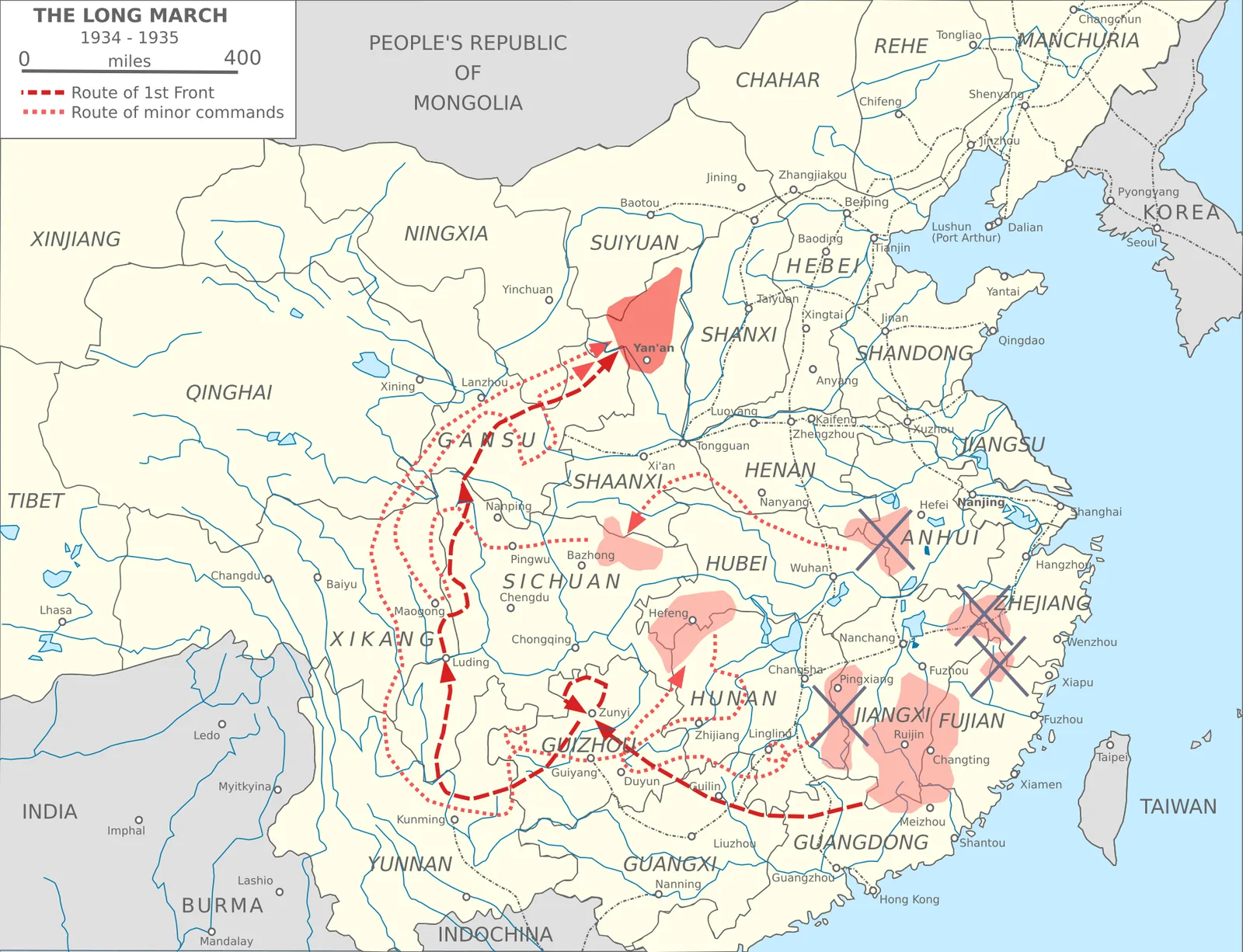
Wikimedia Commons · Creative Commons Attribution-Share Alike 3.0 Unported · file Mao was among the Communist leaders on the Long March, which began when the Red Army broke through at Xinfeng. Mao's participation in the Long March is documented in the article; this sentence identifies its Xinfeng departure point but does not name him individually.
Long March at Loushan Pass
· Loushan Pass, Guizhou, China
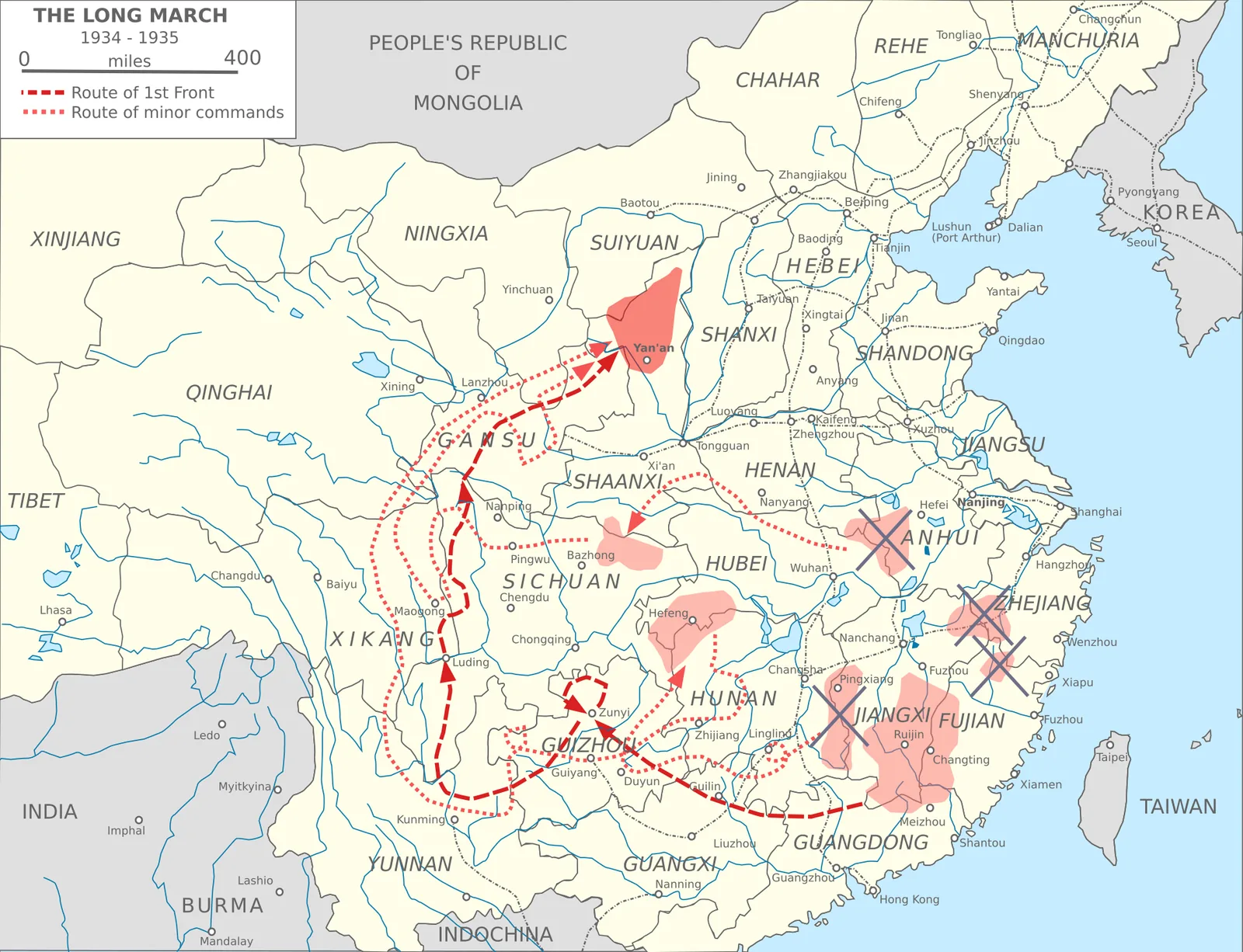
Wikimedia Commons · Creative Commons Attribution-Share Alike 3.0 Unported · file From Zunyi, Mao led his forces to Loushan Pass during the Long March. The source gives no more precise date.
Zunyi Conference
· Zunyi, Guizhou, China
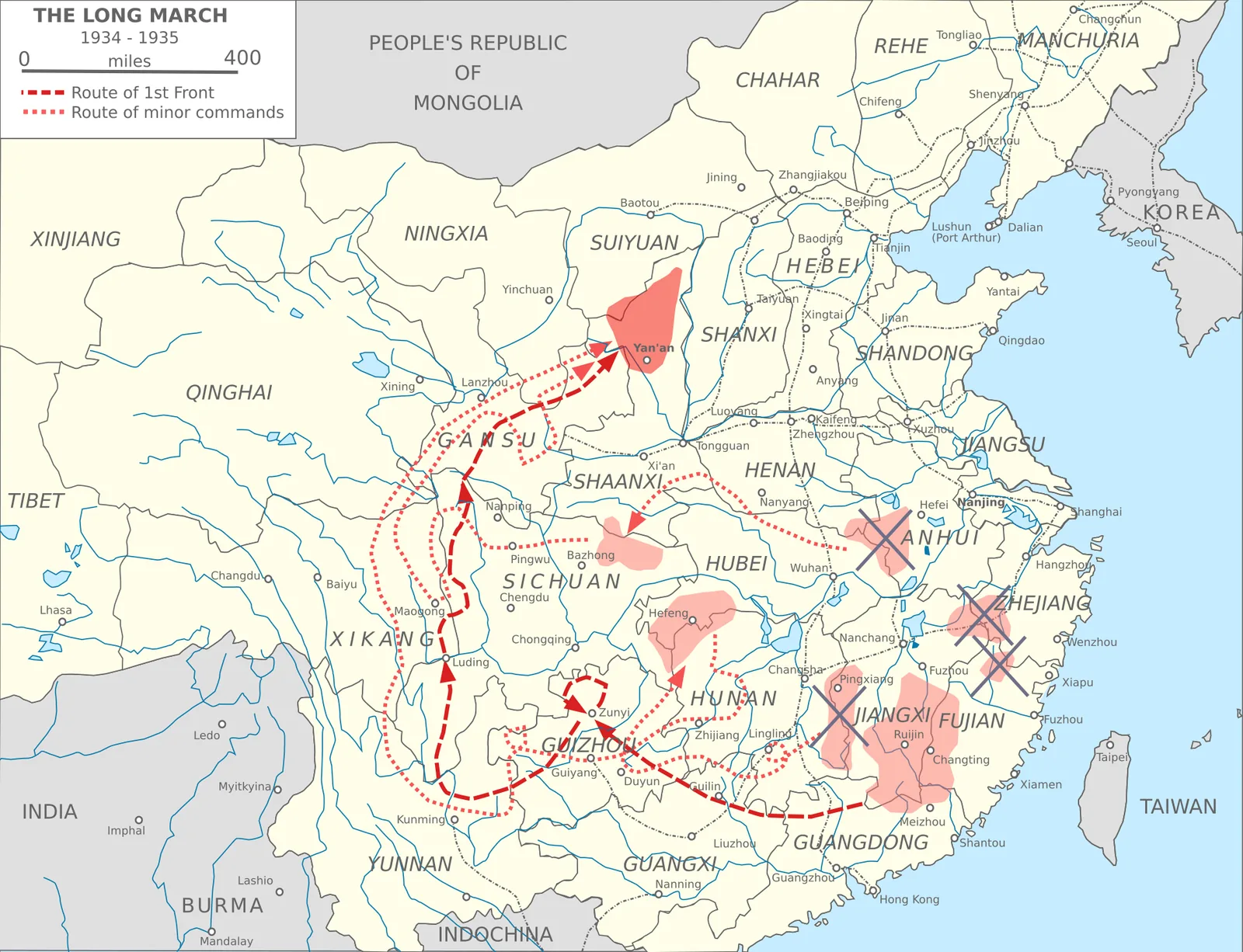
Wikimedia Commons · Creative Commons Attribution-Share Alike 3.0 Unported · file At Zunyi, Mao gained a central leadership position during the Long March conference. The source specifies January 1935 but not the conference days.
Settlement at Bao'an
· Bao'an, Shaanxi, China
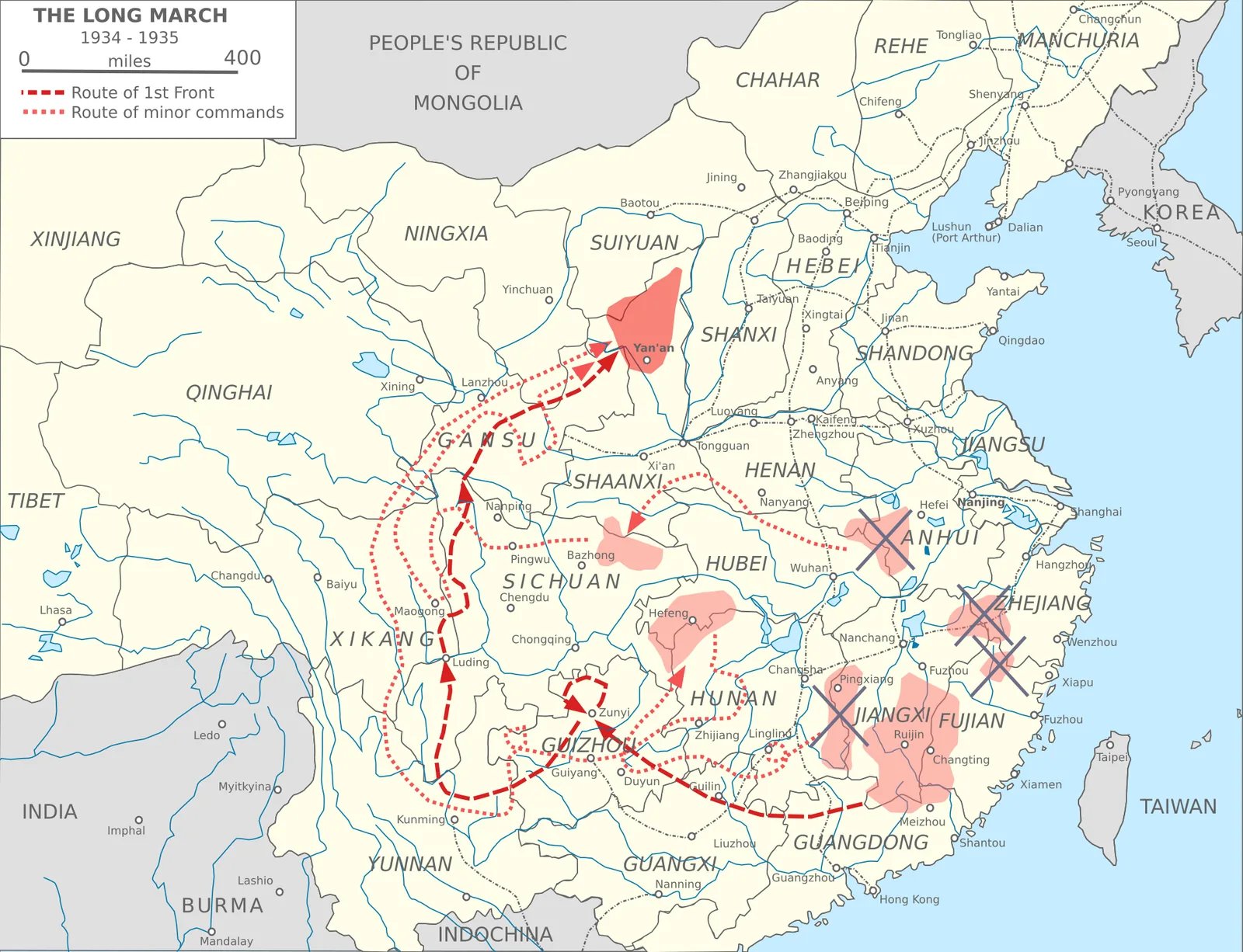
Wikimedia Commons · Creative Commons Attribution-Share Alike 3.0 Unported · file After reaching the Yan'an Soviet, Mao's forces settled at Bao'an, which served as their base until spring 1936. The source identifies Mao's troops rather than Mao by name in this sentence; Mao's command and participation in the Long March are documented in the same article.
Mao in Yan'an
· Yan'an, Shaanxi, China
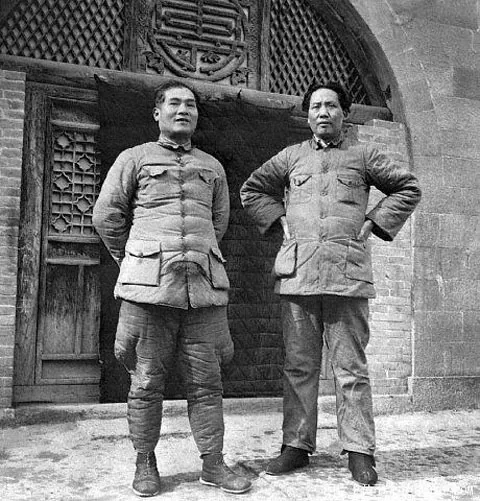
Wikimedia Commons · Public domain · file Mao was photographed with Zhang Guotao in Yan'an during the Communist wartime base period. Evidence is a dated image caption; the source does not provide a month or exact venue.
Seventh CCP National Congress
· Yan'an, Shaanxi, China
Mao delivered his report, On the Coalition Government, at the Seventh National Congress of the CCP in Yan'an. The congress convened in Yan'an from 23 April to 11 June 1945; the report is dated only to April.
Chongqing negotiations
· Chongqing, China
Mao flew from Yan'an to Chongqing to negotiate postwar relations between the CCP and Kuomintang.
Proclamation of the People's Republic
· Tiananmen Gate, Beijing, China
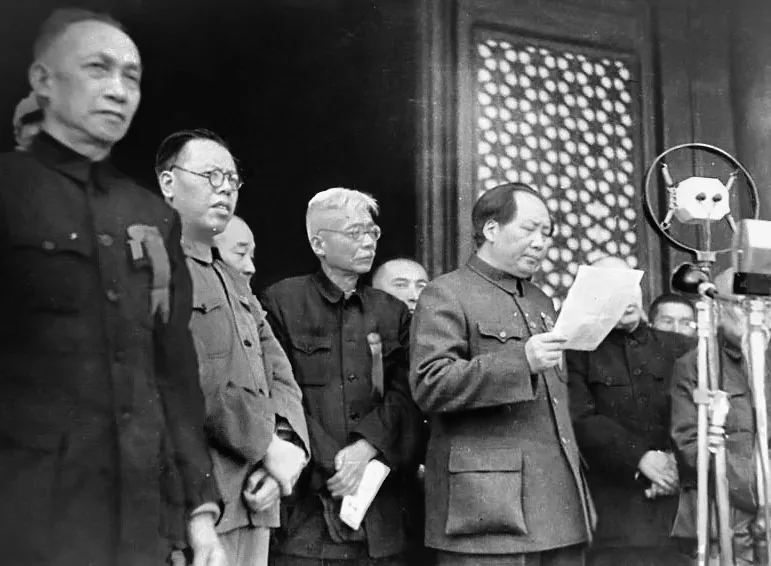
Wikimedia Commons · Creative Commons Attribution-ShareAlike 4.0 International · file Mao publicly proclaimed the establishment of the People's Republic of China from Tiananmen.
First Moscow visit
· Moscow, Russian SFSR, Soviet Union
Mao arrived in Moscow for talks with Stalin and negotiations that led to the Sino-Soviet treaty. Coordinates identify Moscow's city center; the source does not identify an arrival-station coordinate.
Mao–Khrushchev state visit
· Beijing, China
Mao met Soviet leader Nikita Khrushchev during Khrushchev's state visit to Peking. Evidence is a dated image caption; no month or meeting venue is supplied.
Yangtze swim
· Yangtze River, Wuhan, Hubei, China
Mao crossed the Yangtze River at Wuhan in a major public demonstration of vigor at the beginning of the Cultural Revolution. Coordinates represent the Yangtze riverfront at Wuhan; the cited article's surrounding text identifies Wuhan.
Red Guard public appearance
· Beijing, China
Mao appeared publicly with Lin Biao among Red Guards in Beijing during the Cultural Revolution. Evidence is a dated image caption; no exact rally venue is specified.
Meeting with President Nixon
· Mao Zedong Residence, Zhongnanhai, Beijing, China
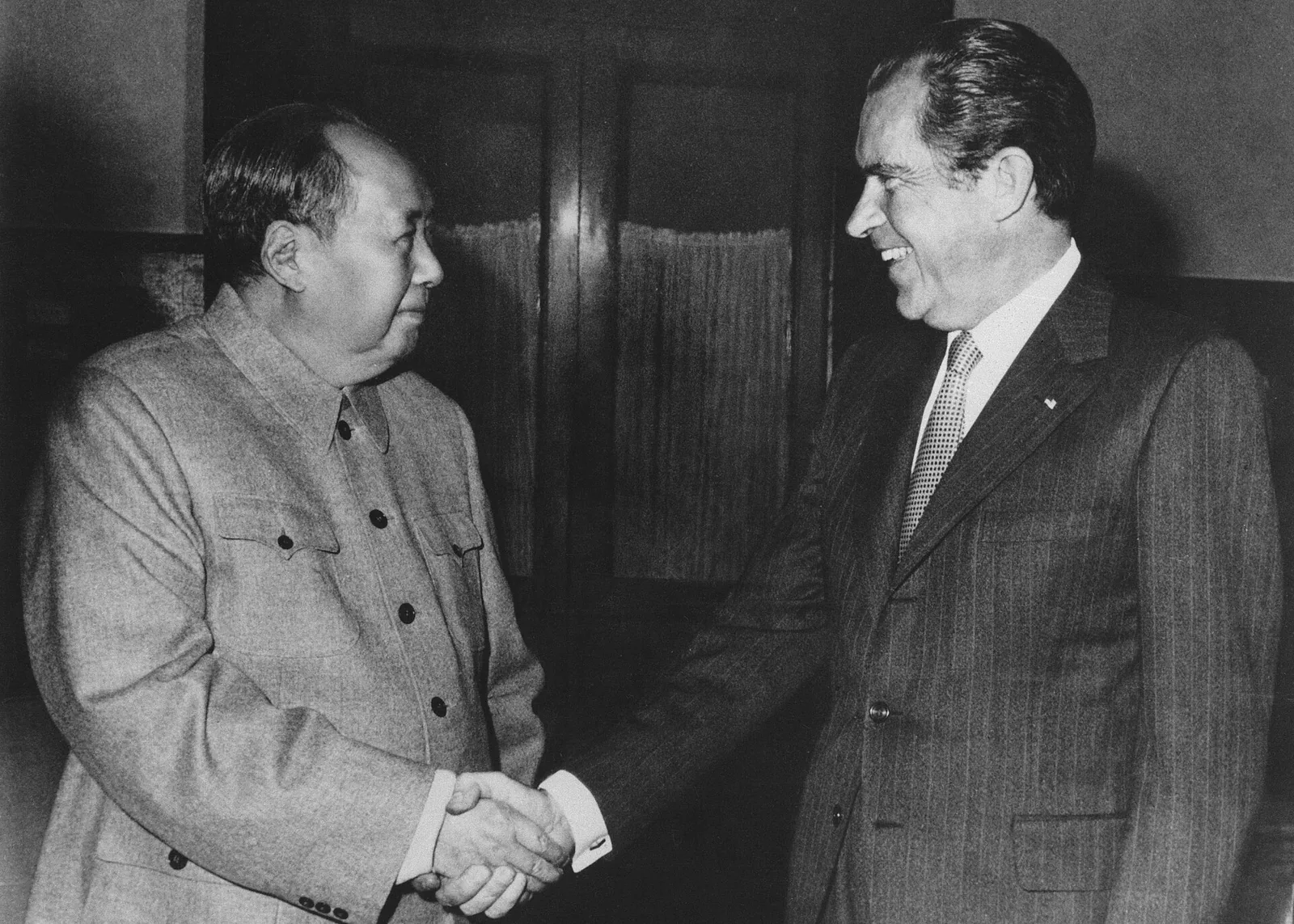
Wikimedia Commons · Public domain Mao met U.S. President Richard Nixon in Beijing during Nixon's historic visit to China. The official U.S. record identifies Beijing for Nixon's visit and Mao's residence, but does not state the residence's street-level location; coordinates represent Zhongnanhai.
Meeting with President Ford
· Mao Zedong Residence, Zhongnanhai, Beijing, China
Mao received U.S. President Gerald Ford and his party at Mao's Beijing residence late in life. The memorandum is headed Beijing, December 2, 1975; coordinates represent Zhongnanhai near the Forbidden City complex.
Death in Beijing
· Beijing, China
Mao died in Beijing after severe illness and multiple heart attacks during his final year. The article's infobox supplies the death date and city; it does not identify a specific building.