
30 moments
Birth in Medellín
· Medellín, Extremadura, Spain
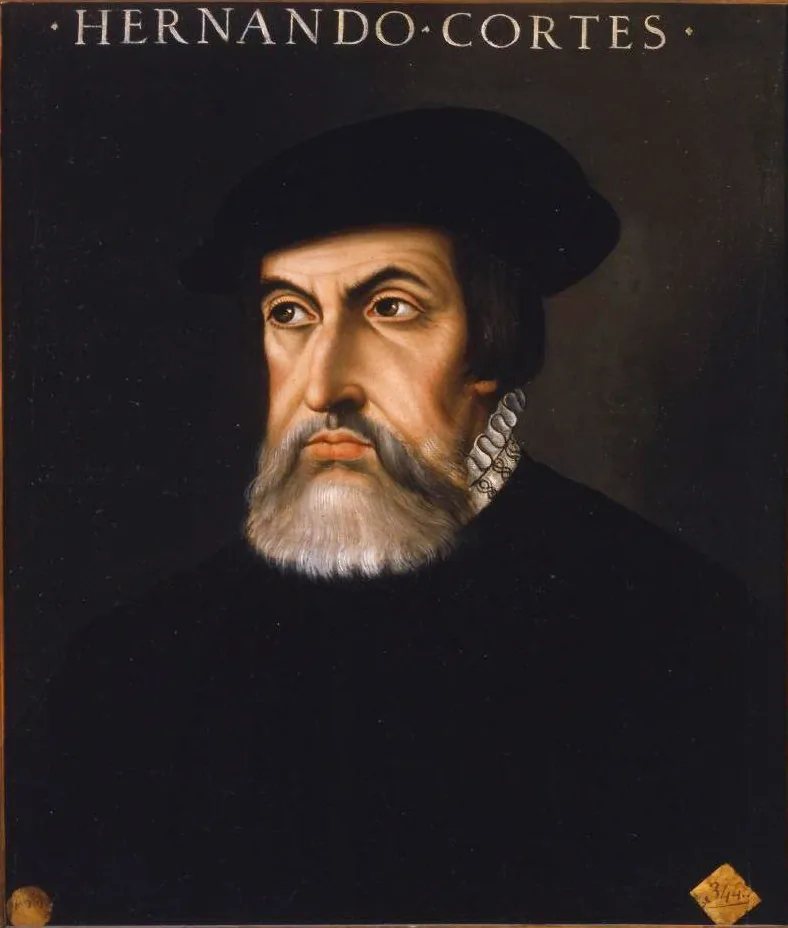
Wikimedia Commons · Public domain (Public Domain Mark 1.0) · file Cortés was born in Medellín, in Extremadura, then within the Kingdom of Castile. The surviving biographical evidence gives an approximate birth year.
Arrival in Santo Domingo
· Santo Domingo, Hispaniola
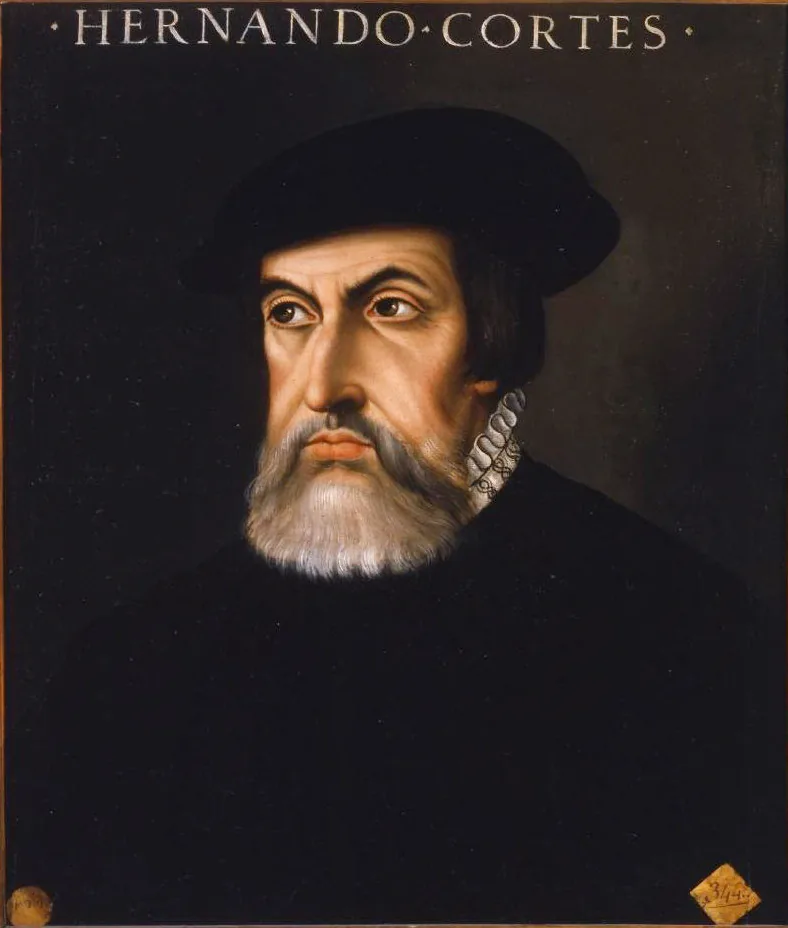
Wikimedia Commons · Public domain (Public Domain Mark 1.0) · file Cortés arrived in the Caribbean colony of Hispaniola and registered as a citizen in Santo Domingo.
Notary at Azua de Compostela
· Azua de Compostela, Dominican Republic
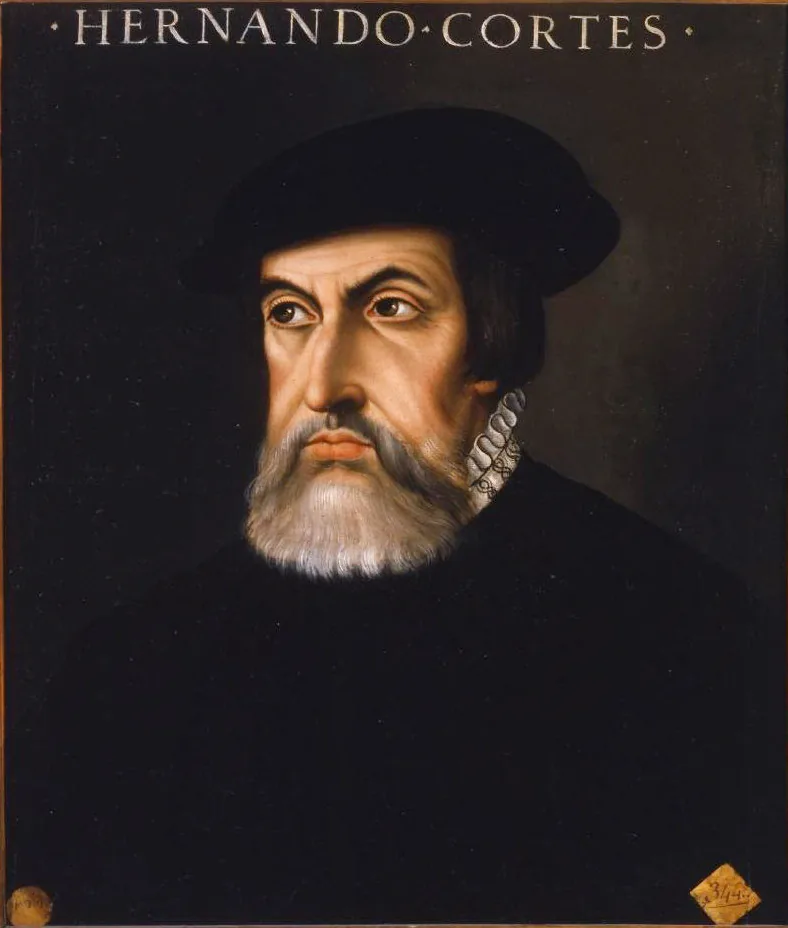
Wikimedia Commons · Public domain (Public Domain Mark 1.0) · file After arriving in Hispaniola, Cortés received an encomienda and became a notary at Azua de Compostela. The appointment followed his 1504 arrival; the source does not provide a more precise date.
Cuba conquest expedition
· Cuba
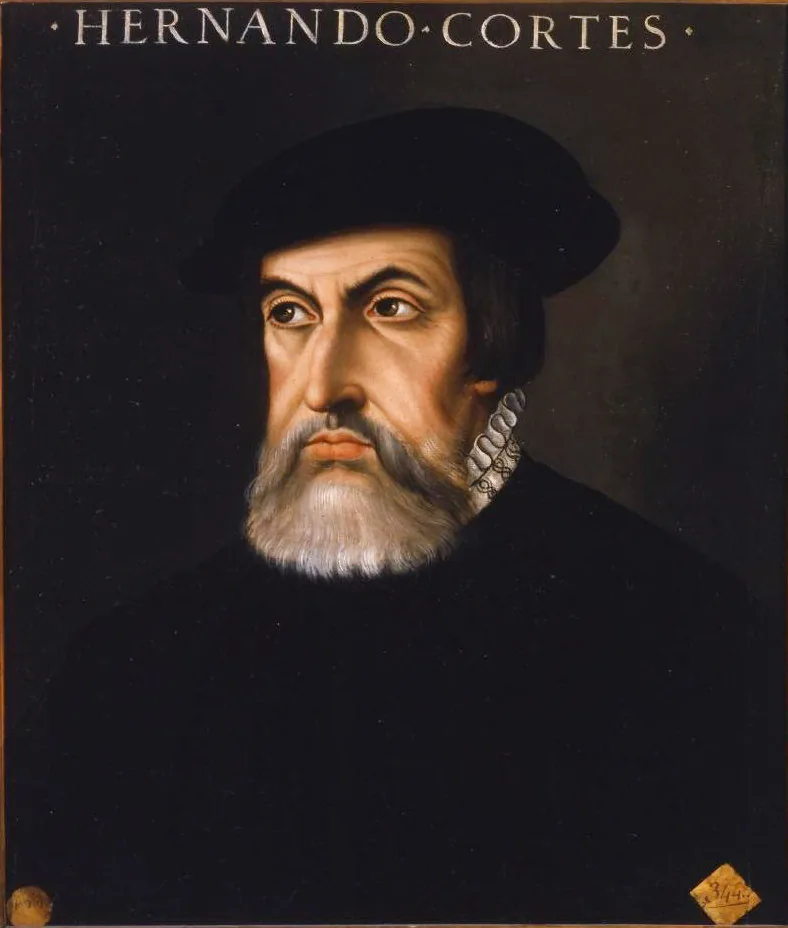
Wikimedia Commons · Public domain (Public Domain Mark 1.0) · file Cortés accompanied Diego Velázquez de Cuéllar's expedition to conquer Cuba, beginning his Cuban career. Coordinate is a representative point for Cuba because the source does not specify a landing site.
Municipal magistrate in Santiago de Cuba
· Santiago de Cuba, Cuba
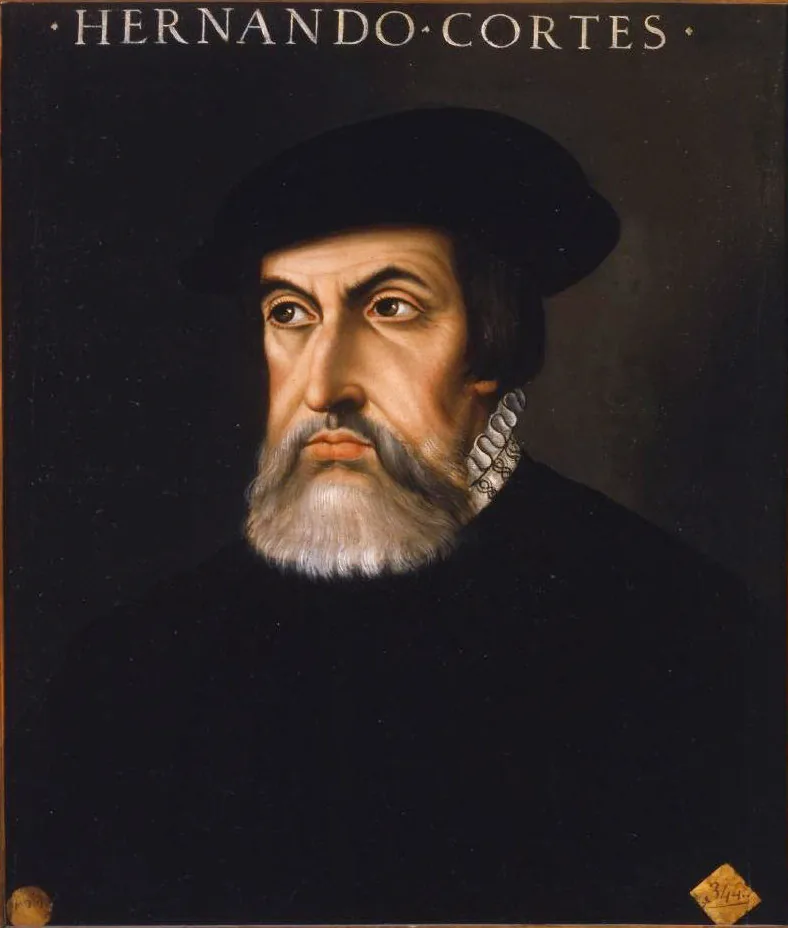
Wikimedia Commons · Public domain (Public Domain Mark 1.0) · file During his Cuban career, Cortés served twice as a municipal magistrate in Santiago, the colony's principal Spanish town. The office is documented during his 1511–1519 residence in Cuba; no precise appointment date is supplied.
Stay on Cozumel
· Cozumel, Quintana Roo, Mexico
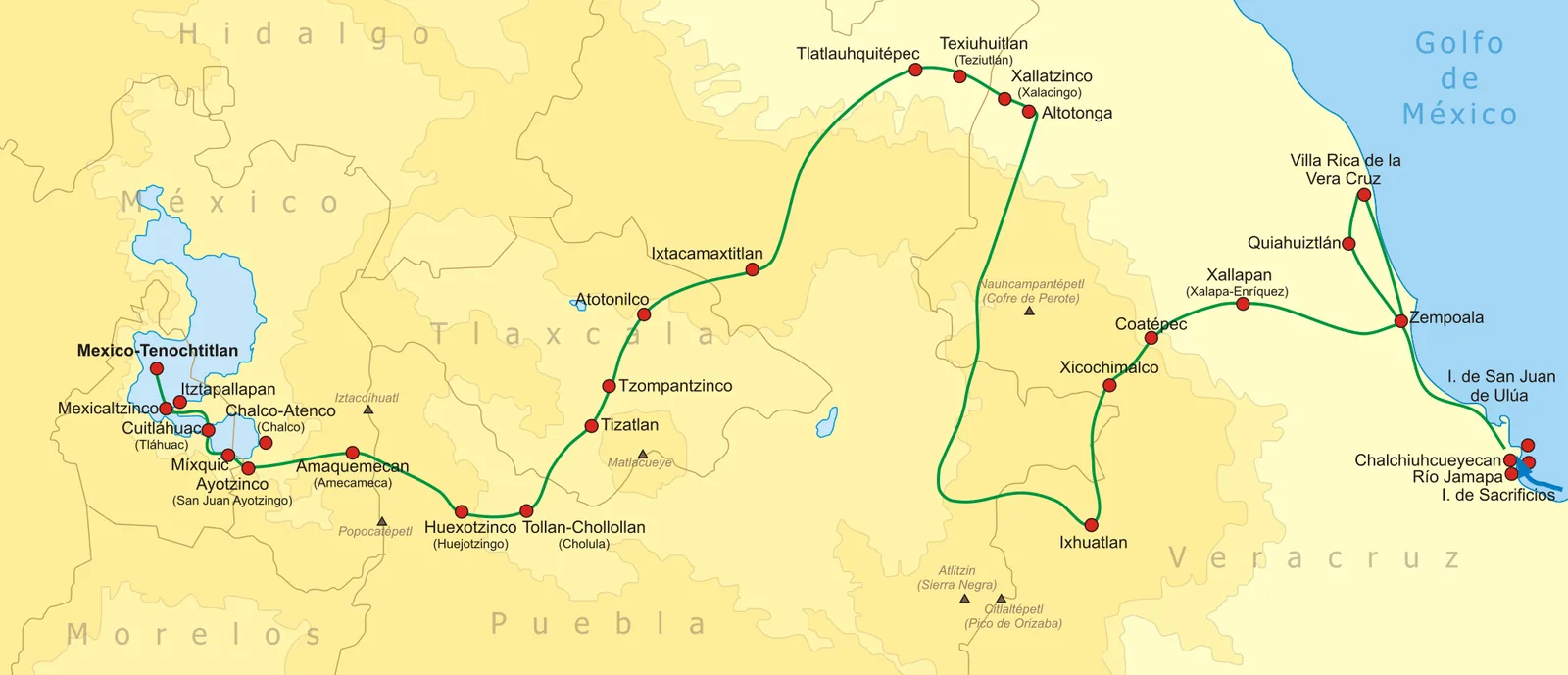
Wikimedia Commons · CC BY 3.0 · file Cortés's fleet made its first landfall at Cozumel, where he remained for several days and secured Gerónimo de Aguilar as an interpreter. The source places this stop in 1519 but does not provide a day or month.
Recruiting stop at Trinidad
· Trinidad, Sancti Spíritus, Cuba
Wikimedia Commons · CC BY 3.0 · file On departing Cuba for the mainland expedition, Cortés stopped at Trinidad to recruit additional soldiers and obtain horses.
Anchorage at Potonchán
· Potonchán, Tabasco, Mexico
Wikimedia Commons · CC BY 3.0 · file Cortés anchored at the Chontal Maya town of Potonchán in Tabasco during the opening stage of the mainland campaign. Potonchán is conventionally associated with the vicinity of modern Frontera; coordinate is representative.
Meeting Aztec governors at San Juan de Ulúa
· San Juan de Ulúa, Veracruz, Mexico
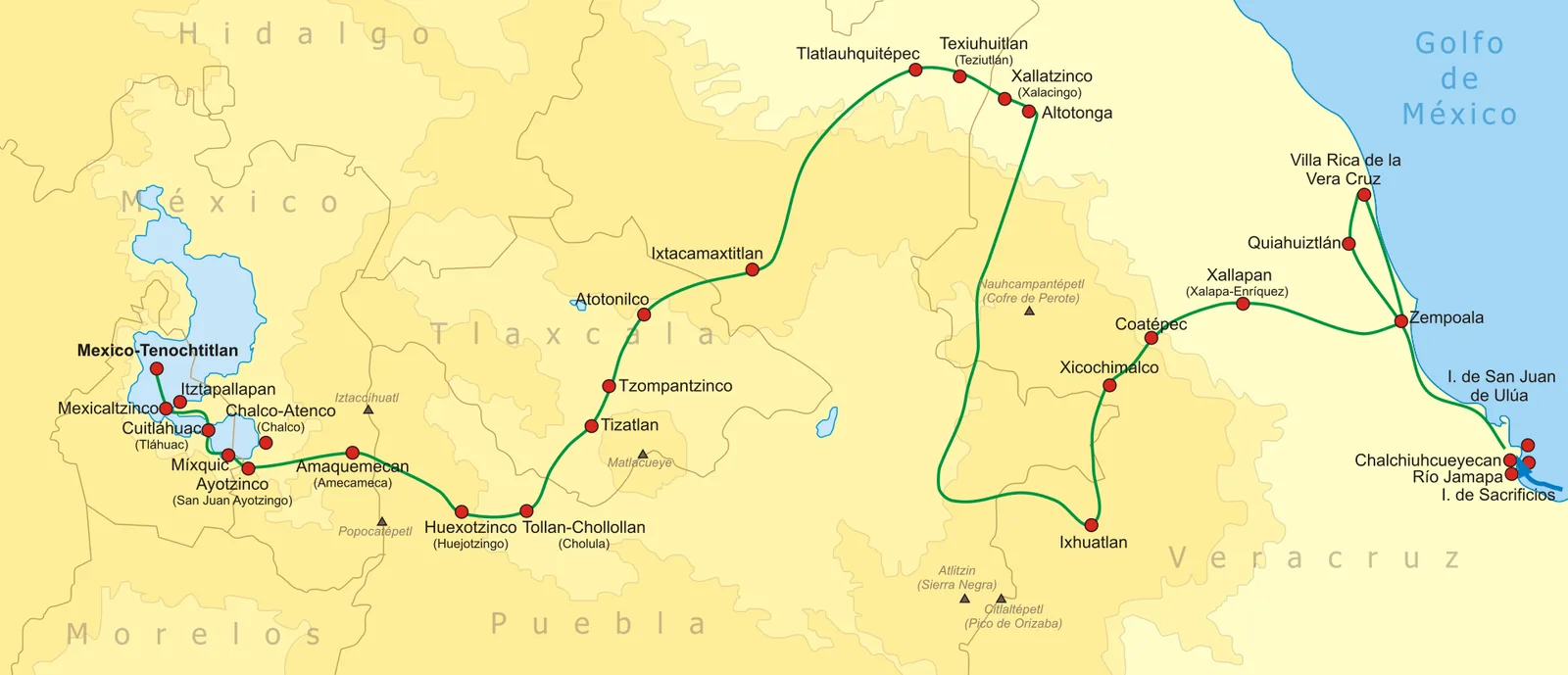
Wikimedia Commons · CC BY 3.0 · file Cortés met Aztec imperial representatives at San Juan de Ulúa on Easter Sunday, shortly after his Gulf-coast landing. Easter Sunday in 1519 fell on 21 April.
Alliance at Cempoala
· Cempoala, Veracruz, Mexico
After establishing Vera Cruz, Cortés traveled to Cempoala and formalized an alliance with its Totonac leader, Xicomecoatl. The itinerary identifies this movement as following the early-June foundation of Vera Cruz.
Foundation of Villa Rica de la Vera Cruz
· Quiahuiztlan, Veracruz, Mexico
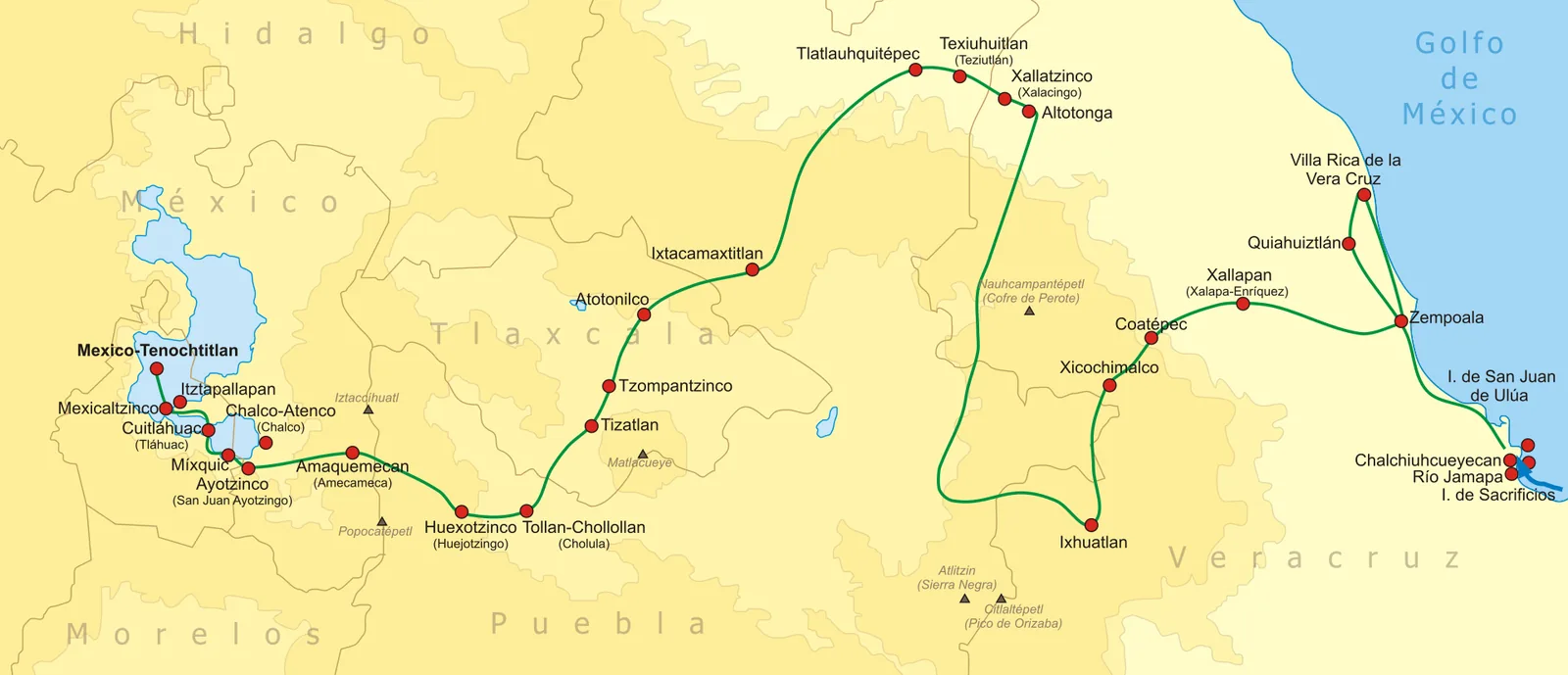
Wikimedia Commons · CC BY 3.0 · file Cortés established the settlement of Villa Rica de la Vera Cruz and moved his company to the beach near Quiahuiztlan. Coordinate marks the Quiahuiztlan archaeological area, the location specified by the source.
Campaign in Tlaxcallan
· Tlaxcala, Mexico
Cortés was present with his expedition during fighting with the Otomis and Tlaxcalans before securing the Tlaxcalan alliance. Coordinate represents Tlaxcala; the fighting occurred across the territory of Tlaxcallan.
March to Cholula
· Cholula, Puebla, Mexico
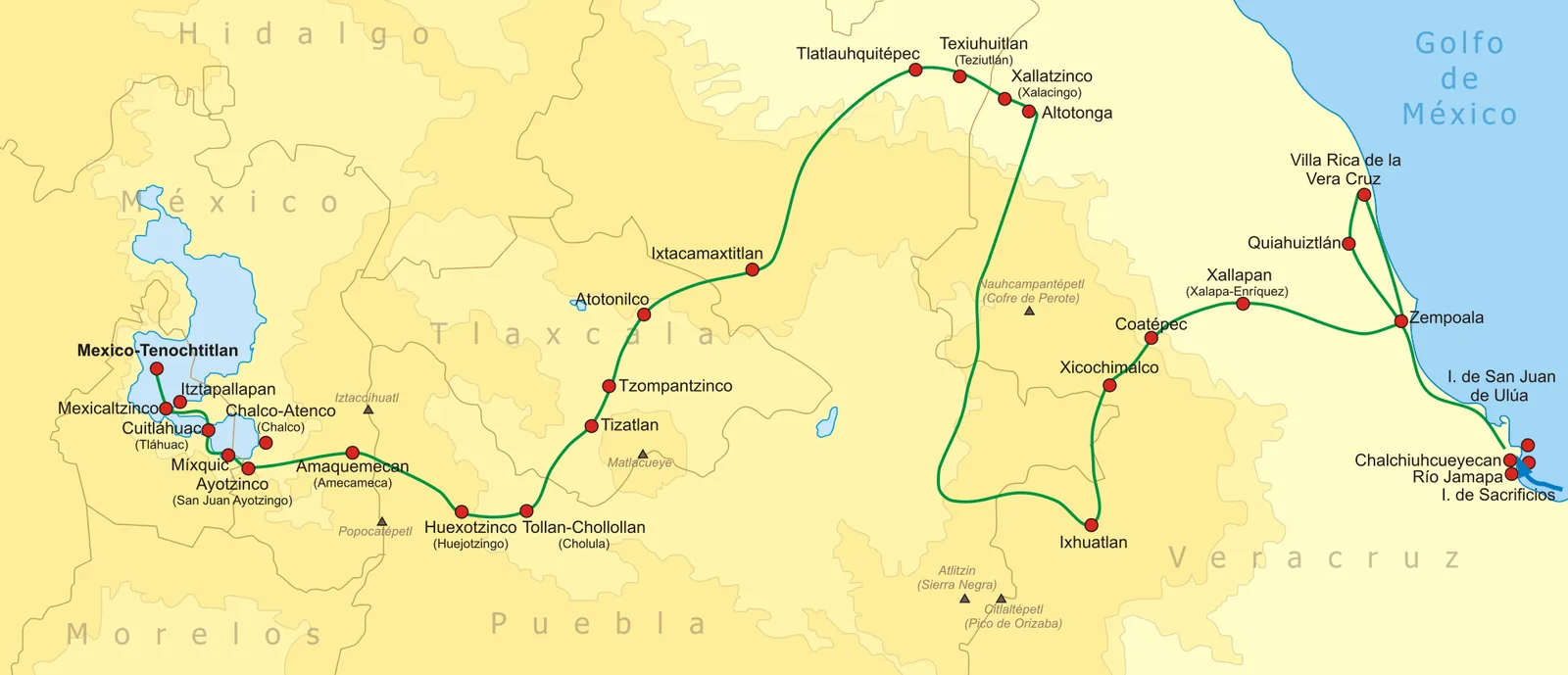
Wikimedia Commons · CC BY 3.0 · file Cortés entered Cholula with Spanish and Tlaxcalan forces in the advance toward Tenochtitlan.
Entry into Tenochtitlan
· Tenochtitlan, Mexico
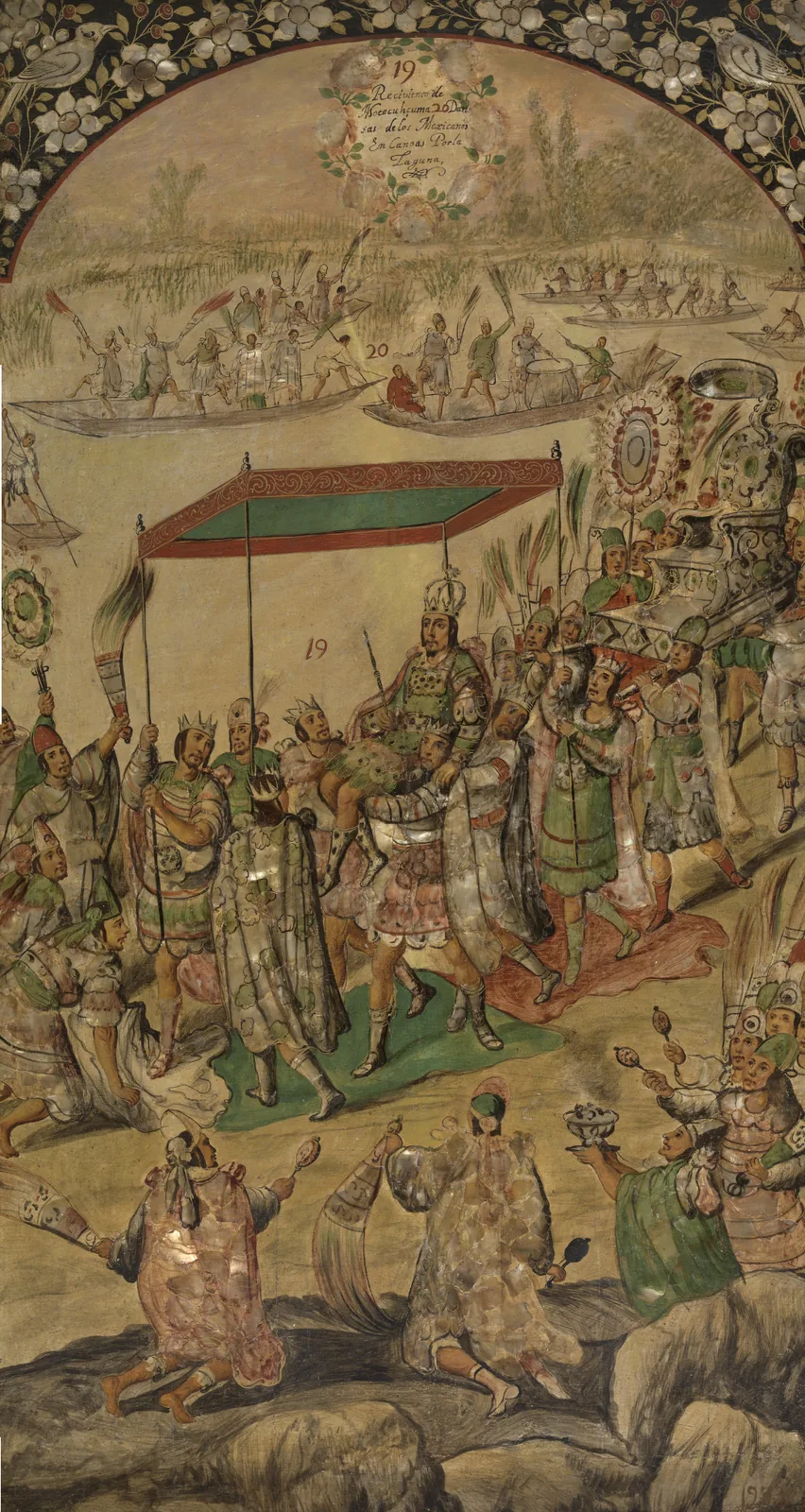
Wikimedia Commons · Public domain · file Cortés entered the Aztec capital, where Moctezuma II received the Spanish-led force peacefully. Coordinate represents the historic island-city site in present-day central Mexico City.
Return to Tenochtitlan during uprising
· Tenochtitlan, Mexico
After confronting Pánfilo de Narváez's expedition, Cortés returned to Tenochtitlan amid a major uprising against the Spanish garrison. The linked conquest chronology dates the Spanish return to 24 June 1520, but the main biography does not specify the day.
Retreat to Tlaxcala
· Tlaxcala, Mexico
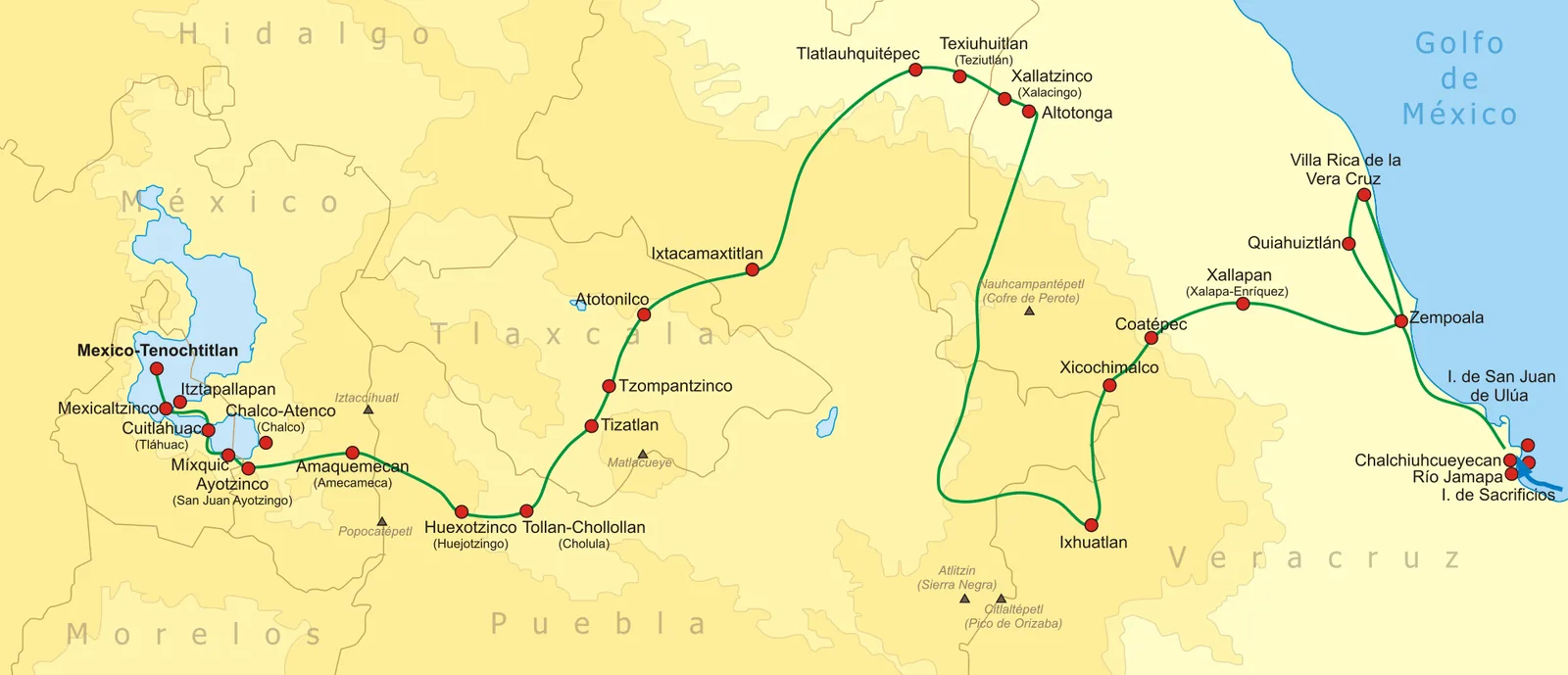
Wikimedia Commons · CC BY 3.0 · file Following the retreat from Tenochtitlan and the battle of Otumba, Cortés and his surviving force reached Tlaxcala. The retreat reached Tlaxcala on 11 or 12 July according to the linked conquest chronology; this card retains month precision because the biography's wording does not specify the day.
Fall of Tenochtitlan
· Tenochtitlan, Mexico
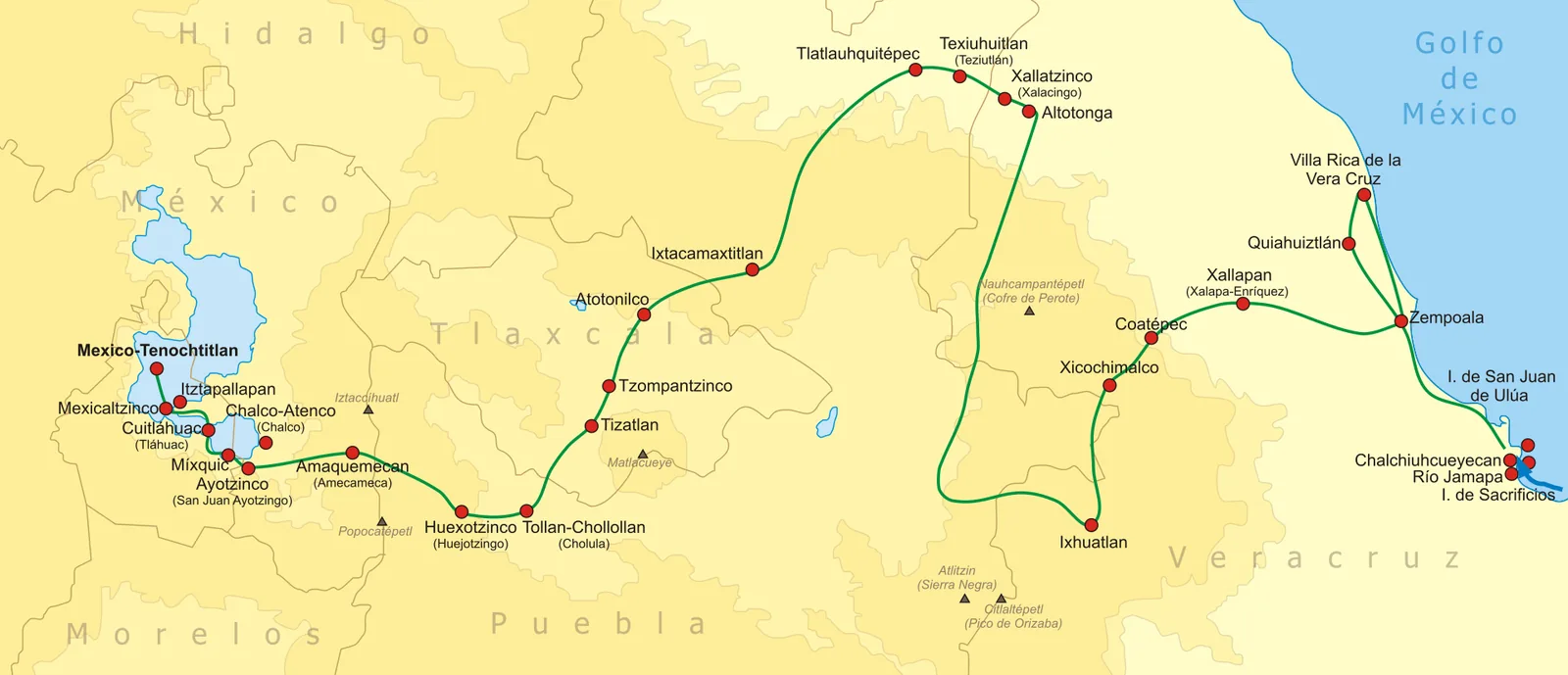
Wikimedia Commons · CC BY 3.0 · file Cortés commanded the Spanish and Indigenous allied army that captured Cuauhtémoc and the Aztec capital at the end of the siege. Coordinate represents the historic Tenochtitlan site.
Residence at Coyoacán
· Coyoacán, Mexico City, Mexico
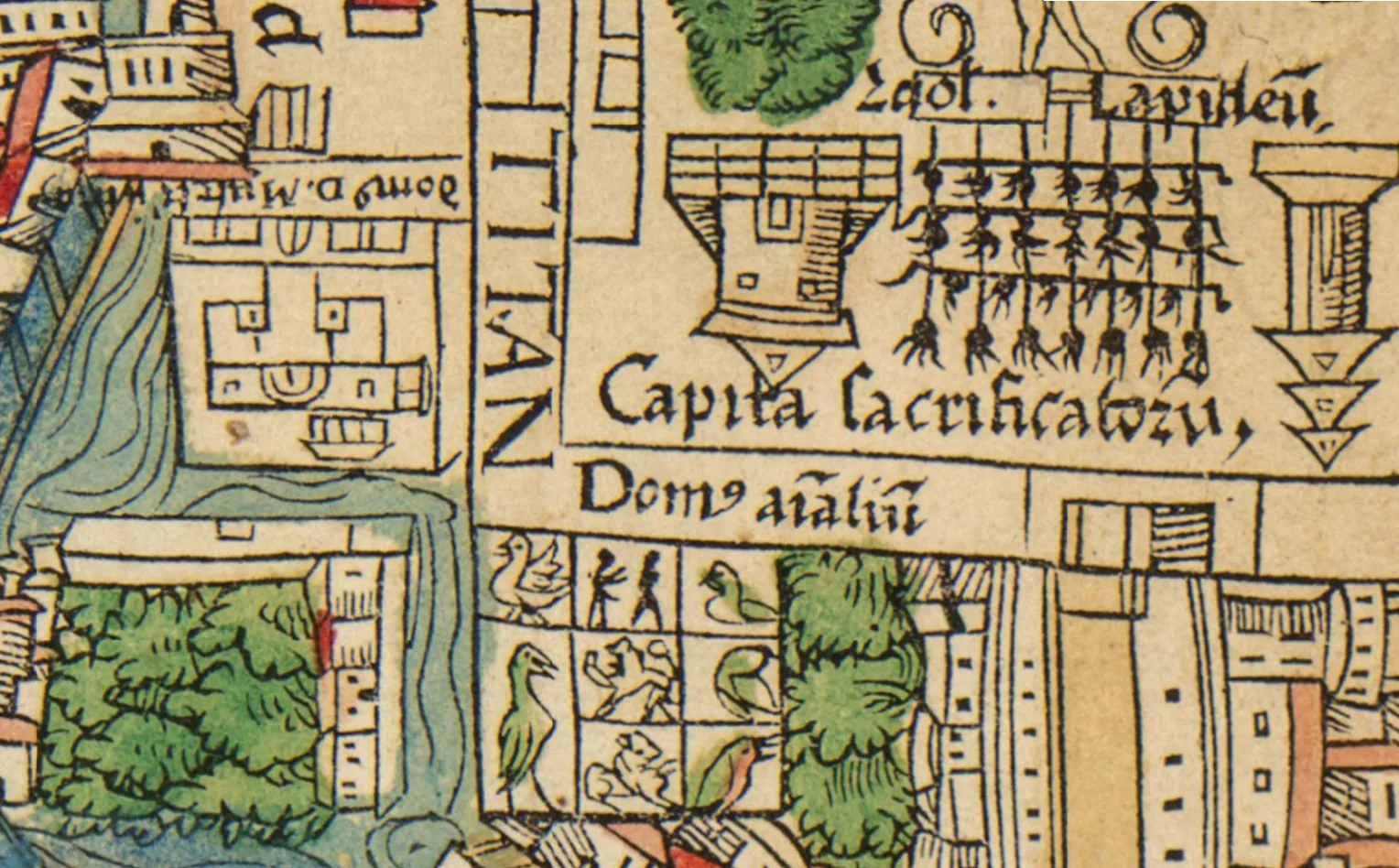
Wikimedia Commons · Public domain · file Cortés was resident at Coyoacán while Mexico City was being constructed after the destruction of Tenochtitlan.
Departure for Honduras
· Tenochtitlan, Mexico
Cortés departed Tenochtitlan with a large Spanish and Mexican force for his overland expedition to Honduras. Coordinate represents the historic Tenochtitlan site.
Administration at Trujillo
· Trujillo, Colón, Honduras
Cortés sailed on to Trujillo, where he found affairs satisfactory and directed communications and operations for Honduras. The source dates Cortés's arrival in Honduras to 1525 but does not specify Trujillo's arrival date.
Crossing to Nito
· Nito, Amatique Bay, Guatemala
During the difficult Honduras march, Cortés crossed the Dulce River to Nito on Amatique Bay and waited for his force to regroup. The precise location of Nito is uncertain; coordinate is a representative point on Amatique Bay.
Sailing to Puerto de Caballos
· Puerto de Caballos, Honduras
After abandoning an attempt to colonize Nito, Cortés sailed with his entire company to Puerto de Caballos. Coordinate marks the modern Puerto Cortés area, associated with the historical harbor.
Passage through Acalan
· Acalan, Campeche, Mexico
Cortés's Honduras expedition passed through the Chontal Maya province of Acalan; after ordering executions there, the force departed on 5 March. Acalan was a historical Chontal Maya province rather than a precisely fixed modern settlement; coordinate is representative.
Arrival at Lake Petén Itzá
· Nojpetén, Lake Petén Itzá, Guatemala
Cortés reached Lake Petén Itzá and crossed to Nojpetén with a small Spanish party to meet the Itza ruler. Coordinate marks the site of Nojpetén, on Flores Island in Lake Petén Itzá.
Return to Mexico City
· Mexico City, Mexico
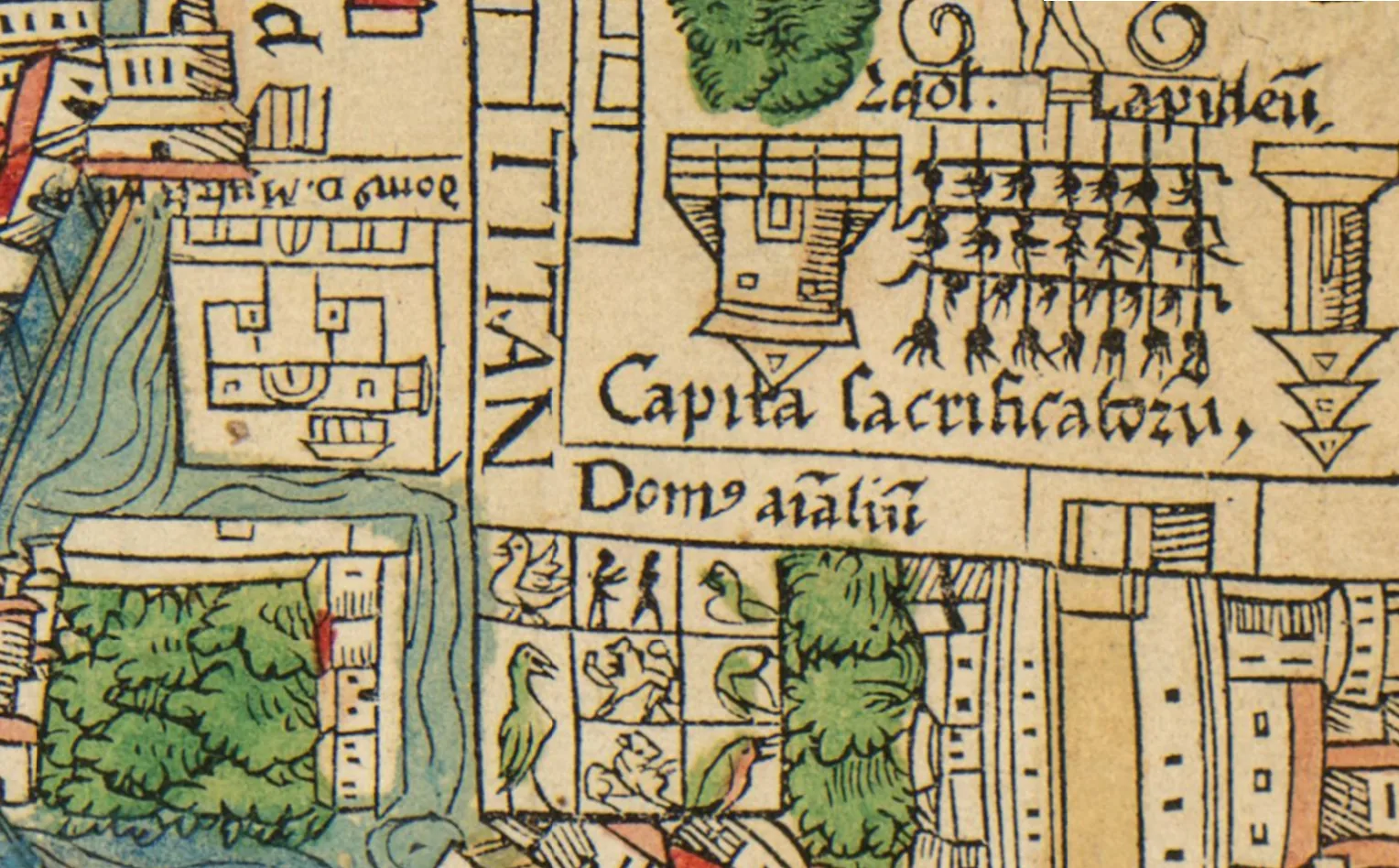
Wikimedia Commons · Public domain · file After the Honduras expedition, Cortés returned to Mexico City and rested at the Franciscan monastery before political proceedings resumed.
First return to Spain
· Spain
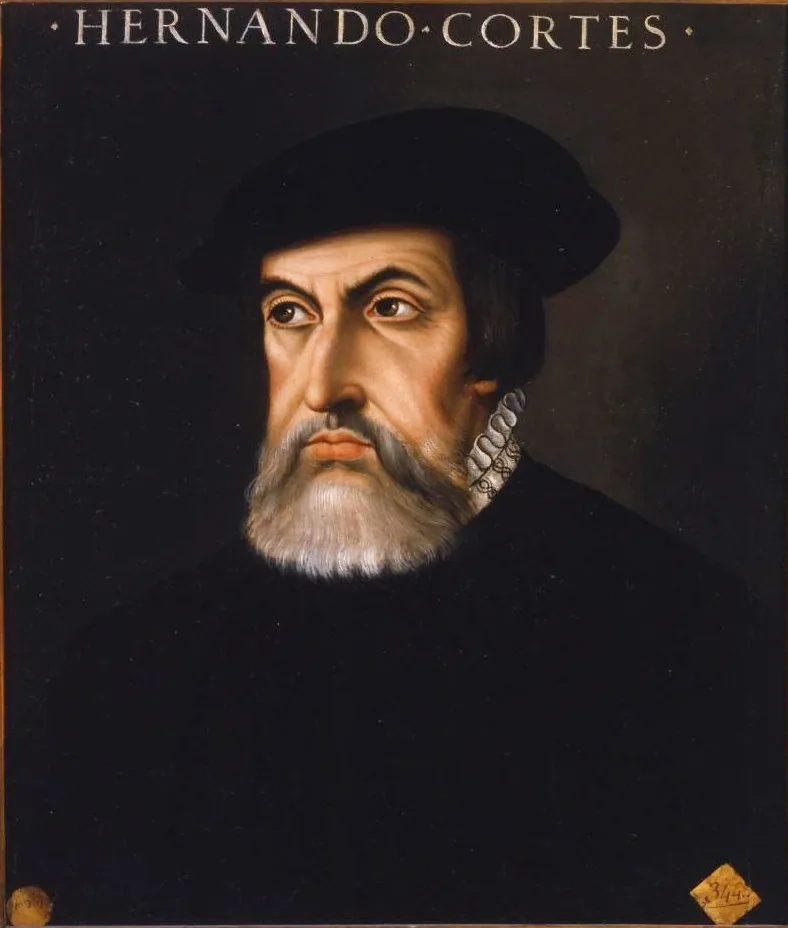
Wikimedia Commons · Public domain (Public Domain Mark 1.0) · file Cortés reached Spain with treasure and forty Aztecs to present his case before Charles V's court. The source identifies Spain but not an arrival port or city; coordinate is a representative national point.
Retirement at Cuernavaca
· Cuernavaca, Morelos, Mexico
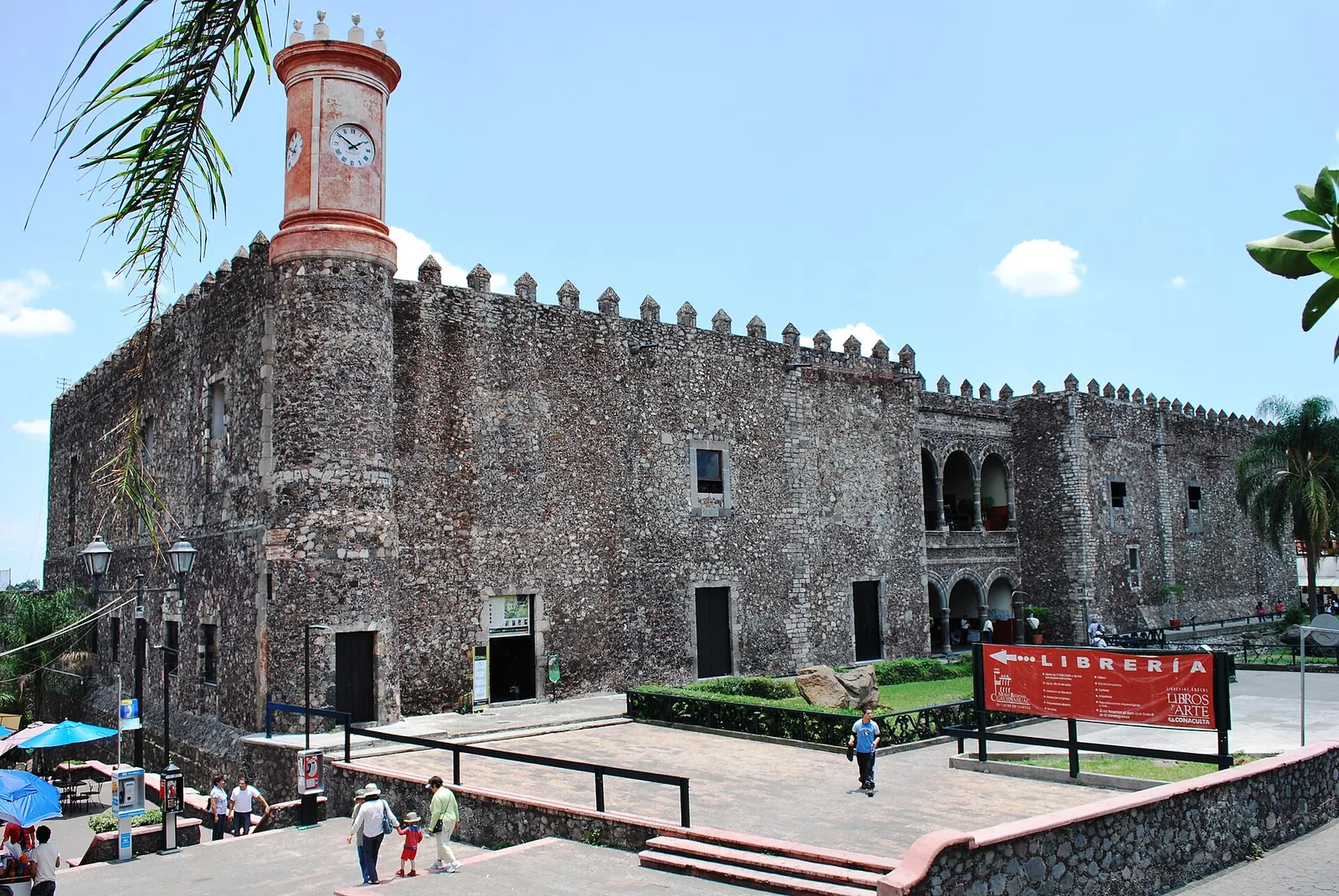
Wikimedia Commons · CC BY-SA 3.0 · file After returning to Mexico, Cortés retired to his estates at Cuernavaca, where he pursued palace construction and Pacific exploration. The source states that Cortés returned to Mexico in 1530 and remained there until 1541.
Exploration of Baja California
· Baja California Peninsula, Mexico
Cortés explored northwestern Mexico and the Baja California peninsula during his final major expedition in the Americas. The source gives the peninsula rather than a landing place; coordinate is a representative central peninsula point.
Algiers expedition
· Algiers, Algeria
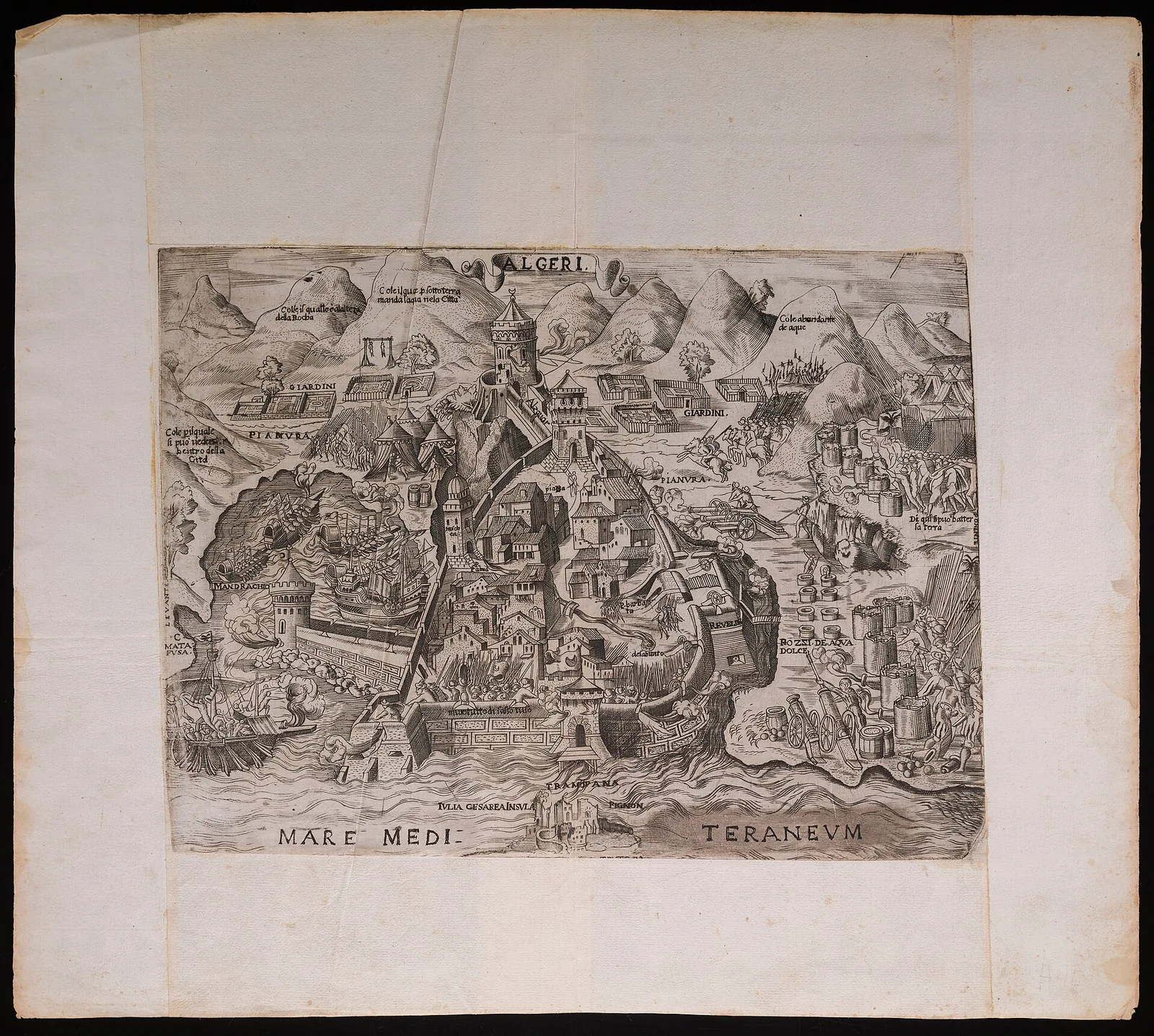
Wikimedia Commons · Public domain (Public Domain Mark 1.0) · file Cortés accompanied Charles V's expedition against Algiers; the fleet arrived before the city as a storm formed. Coordinate represents Algiers; the quoted evidence places Cortés with the fleet offshore.
Death at Castilleja de la Cuesta
· Castilleja de la Cuesta, Andalusia, Spain
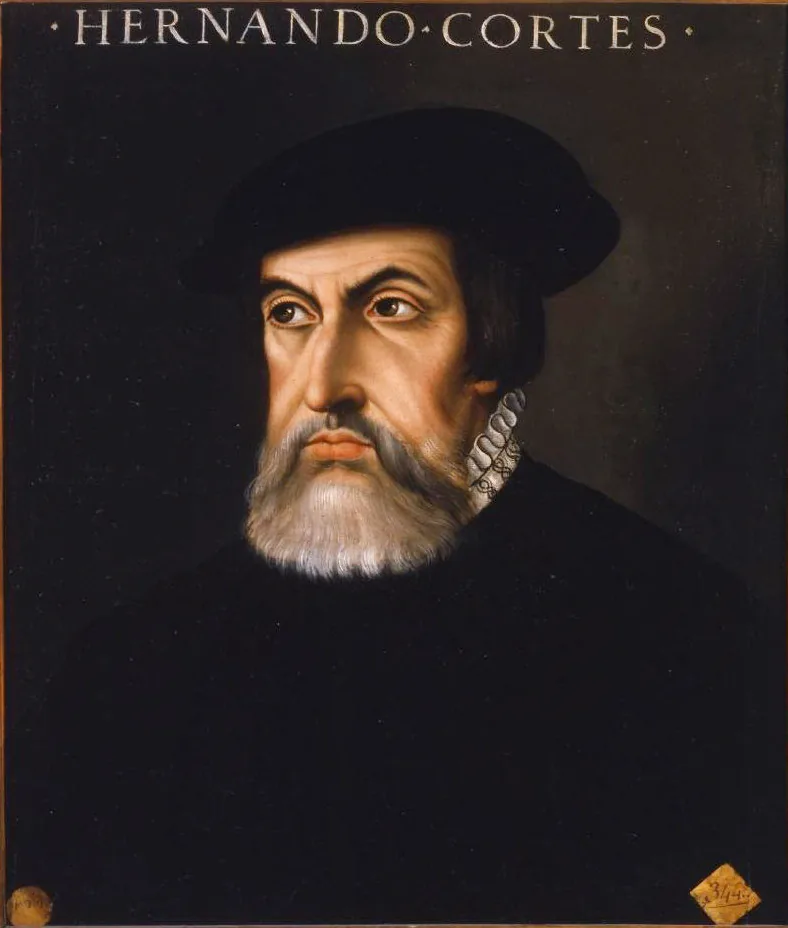
Wikimedia Commons · Public domain (Public Domain Mark 1.0) · file While attempting to return to Mexico, Cortés reached Seville, became ill, and died at Castilleja de la Cuesta.