
33 moments
Birth in Qiao County
· Qiao County, Pei State (present-day Bozhou, Anhui, China)
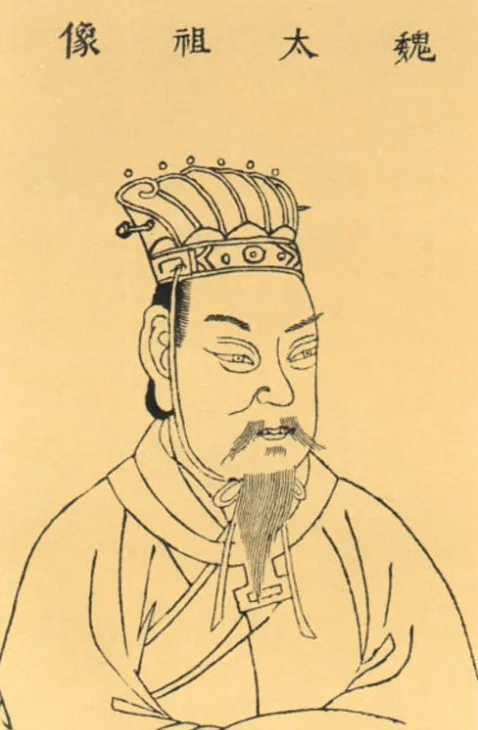
Wikimedia Commons · Public domain · file Cao Cao was born in Qiao County of Pei State, the area represented here by modern Bozhou in Anhui. The source dates his birth c. 155; coordinates represent modern Bozhou rather than an identified Han-period birth site.
Chancellor of Jinan
· Jinan State (present-day Jinan, Shandong, China)
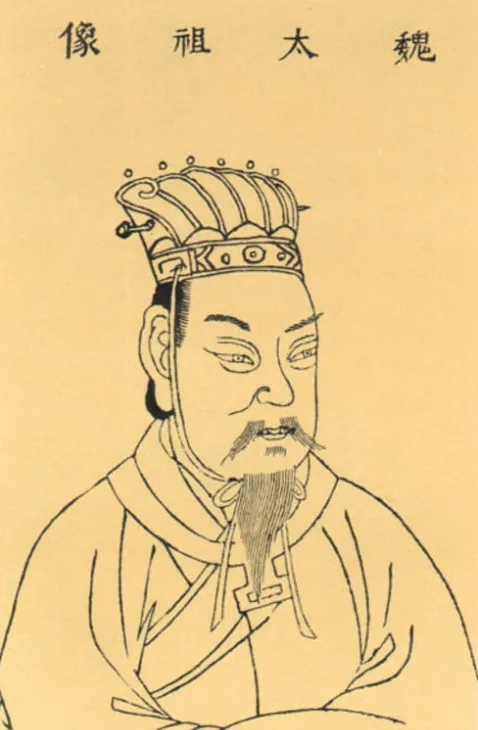
Wikimedia Commons · Public domain · file After the Yingchuan campaign, Cao Cao became Chancellor of Jinan State, a principality in Qing Province. The appointment followed the 184 campaign; coordinates represent modern Jinan.
Yellow Turban campaign in Yingchuan
· Yingchuan Commandery (near present-day Xuchang, Henan, China)
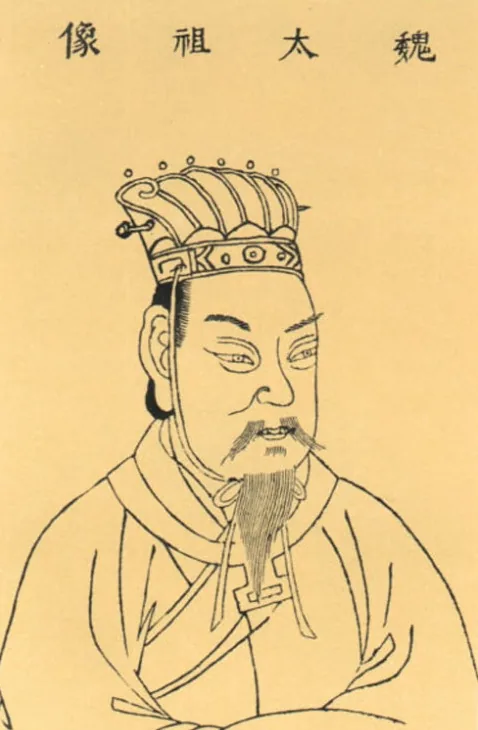
Wikimedia Commons · Public domain · file Appointed Cavalry Commandant during the Yellow Turban Rebellion, Cao Cao led imperial forces against rebels in Yingchuan Commandery. Coordinates represent present-day Xuchang, the source's stated modern reference point for the commandery.
Raising an army at Jiwu
· Jiwu County (southwest of present-day Ningling County, Henan, China)
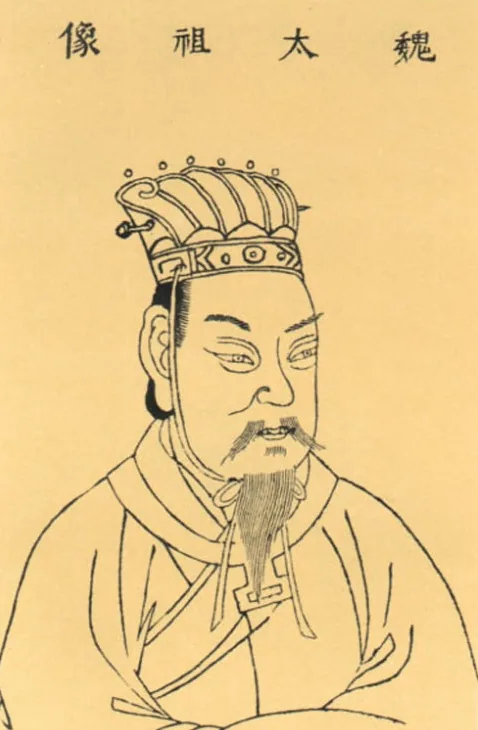
Wikimedia Commons · Public domain · file In the winter of 189, Cao Cao assembled an army at Jiwu and declared war on Dong Zhuo. Ancient Jiwu's precise site is uncertain; coordinates are a representative point southwest of Ningling County.
Battle of Xingyang
· Xingyang, Henan, China
During the anti-Dong Zhuo coalition campaign, Cao Cao personally pursued Dong Zhuo's retreating forces and was defeated at Xingyang. Coordinates represent modern Xingyang; the battle site is broader than the modern urban center.
Return to the Suanzao coalition base
· Suanzao County (near present-day Yanjin County, Henan, China)
After Xingyang, Cao Cao returned to the coalition base at Suanzao and addressed the coalition members about continuing the war. Coordinates are representative for the ancient county, southwest of modern Yanjin.
Campaign in Xu Province
· Xu Province (represented by Xuzhou, Jiangsu, China)
Cao Cao began his first invasion of Xu Province in autumn 193 against Tao Qian. The source supports presence in the province but not a single precise site; coordinates represent Xuzhou.
Victory at Fengqiu
· Fengqiu, Henan, China
Cao Cao defeated Yuan Shu at Fengqiu in the spring of 193 during their struggle in central China. Coordinates represent modern Fengqiu County.
Stalemate at Puyang
· Puyang, Henan, China
After returning from Xu Province, Cao Cao fought Lü Bu at Puyang and survived an ambush there. Coordinates represent modern Puyang.
Escorting the court to Xuchang
· Xuchang, Henan, China
Cao Cao escorted Emperor Xian and the Han court to Xu, thereafter Xuchang, establishing the new imperial capital there. The source dates the move to October or early November 196.
Receiving Emperor Xian at Luoyang
· Luoyang, Henan, China
Cao Cao went to the ruins of Luoyang and received Emperor Xian, a decisive step in gaining control of the Han central government. The source dates this event between August and September 196.
Attack on Wancheng
· Wancheng, Nanyang, Henan, China
Cao Cao led his army to Wancheng to attack Zhang Xiu; the campaign ended in a surprise attack that killed several of Cao Cao's close associates. Coordinates represent Wancheng District in modern Nanyang.
Battle of Xiapi
· Xiapi (near present-day Pizhou, Jiangsu, China)
Cao Cao and Liu Bei combined forces against Lü Bu at Xiapi; the victory removed Lü Bu as a major rival. Coordinates represent modern Pizhou, the source's stated modern reference point for Xiapi.
Raid on Wuchao during Guandu
· Wuchao (southeast of present-day Yanjin County, Henan, China)
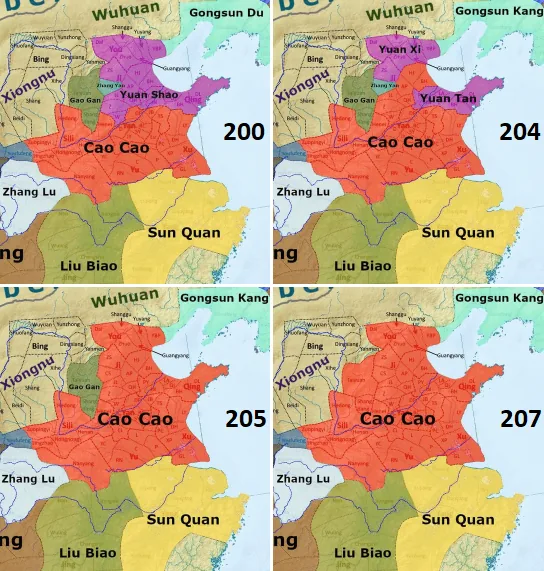
Wikimedia Commons · Creative Commons Attribution-Share Alike 4.0 International · file During the Guandu campaign, Cao Cao personally led a cavalry raid on Yuan Shao's supply depot at Wuchao. The source dates the raid to winter 200; coordinates are representative for the ancient depot area.
Campaign against the Yuan brothers at Ye
· Ye (present-day Handan area, Hebei, China)
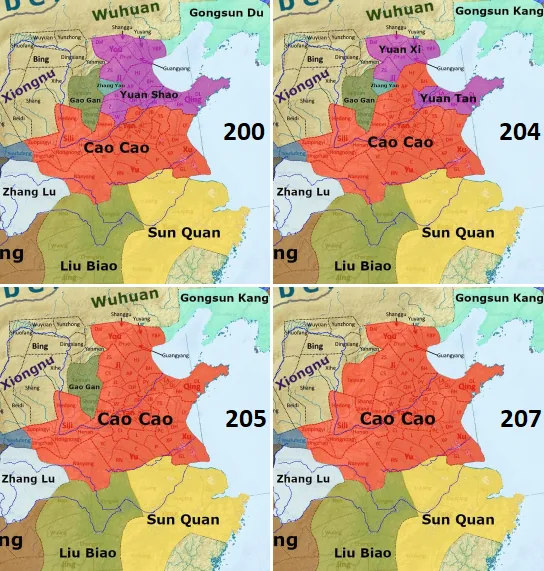
Wikimedia Commons · Creative Commons Attribution-Share Alike 4.0 International · file Cao Cao attacked Yuan Shang at Ye and conquered the city, consolidating his position in northern China. Coordinates represent the Ye/Handan area; the ancient city site lies near modern Anyang-Handan regional boundaries.
Battle of White Wolf Mountain
· White Wolf Mountain (near Lingyuan, Liaoning, China)
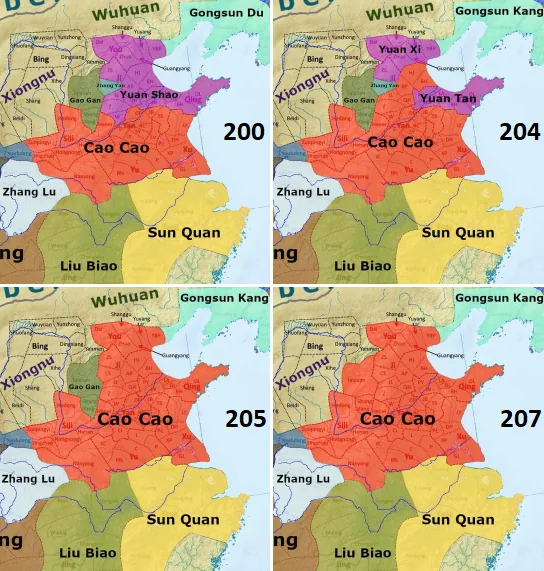
Wikimedia Commons · Creative Commons Attribution-Share Alike 4.0 International · file Cao Cao led a northern expedition against the Wuhuan and Yuan Shao's sons, winning at White Wolf Mountain. The battle is placed near modern Lingyuan; the precise historical battlefield remains approximate.
Advance from Jiangling to Baqiu
· Baqiu (present-day Yueyang, Hunan, China)
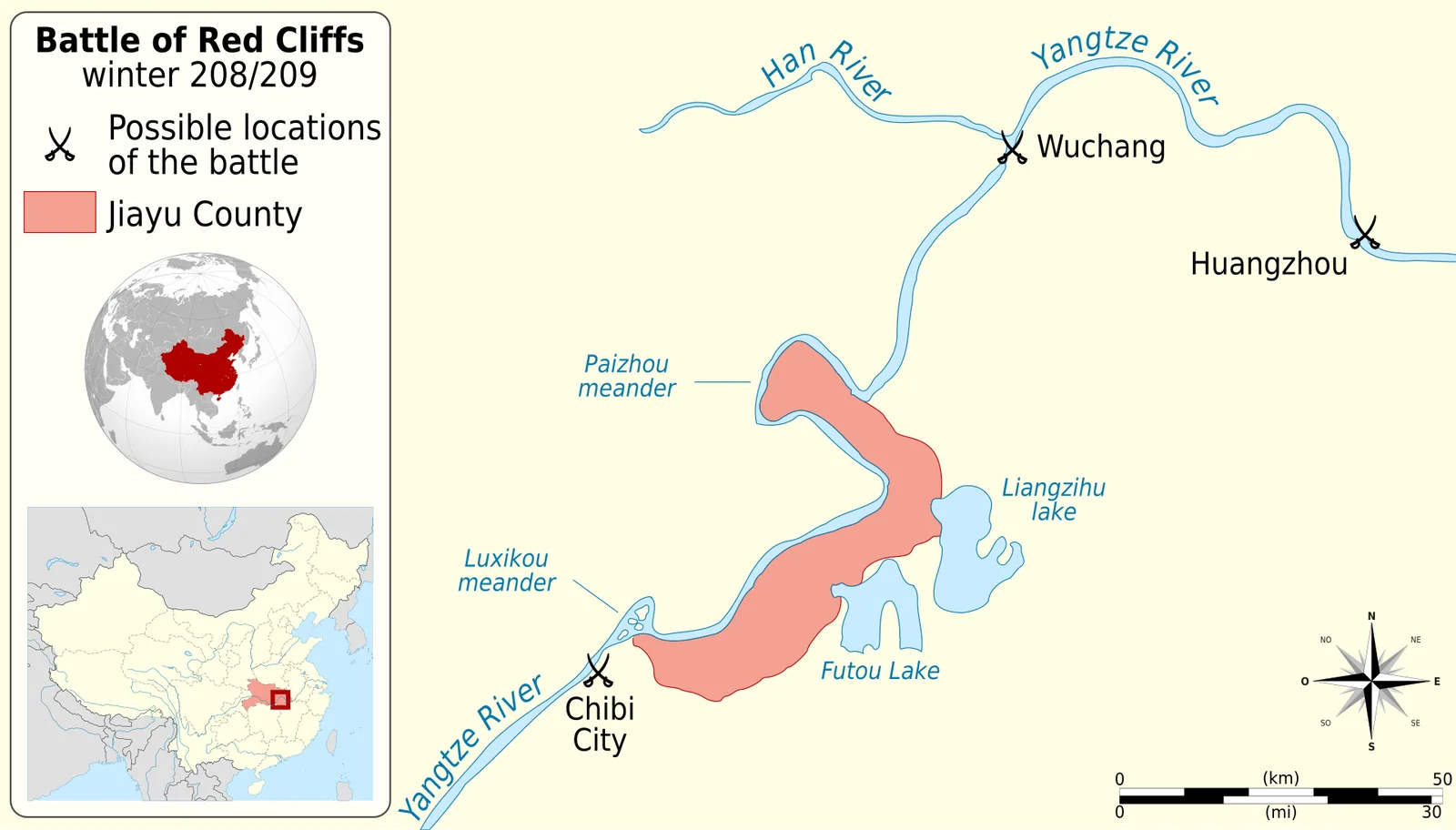
Wikimedia Commons · Creative Commons Attribution-Share Alike 3.0 Unported · file Cao Cao led his forces from Jiangling toward Liu Bei and reached Baqiu before advancing toward Red Cliffs. Coordinates represent modern Yueyang, identified by the source as present-day Baqiu.
Battle of Red Cliffs
· Red Cliffs battlefield, Yangtze River near Chibi, Hubei, China
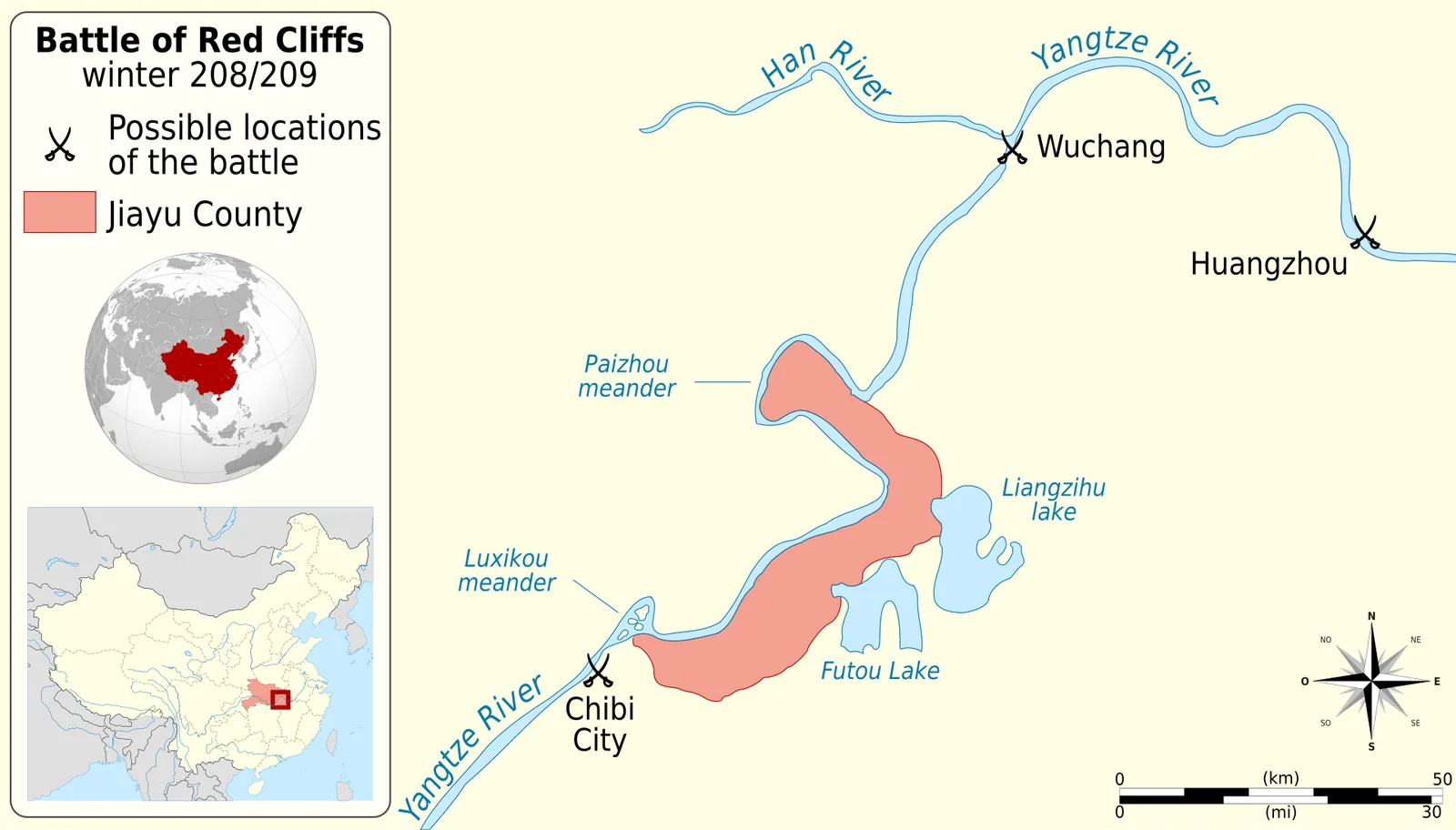
Wikimedia Commons · Creative Commons Attribution-Share Alike 3.0 Unported · file Cao Cao's forces reached Red Cliffs and fought the allied forces of Liu Bei and Sun Quan, suffering a major defeat. The precise battlefield location is historically debated; coordinates use a widely accepted candidate site near Chibi.
Return to Ye after northern pacification
· Ye (present-day Handan area, Hebei, China)
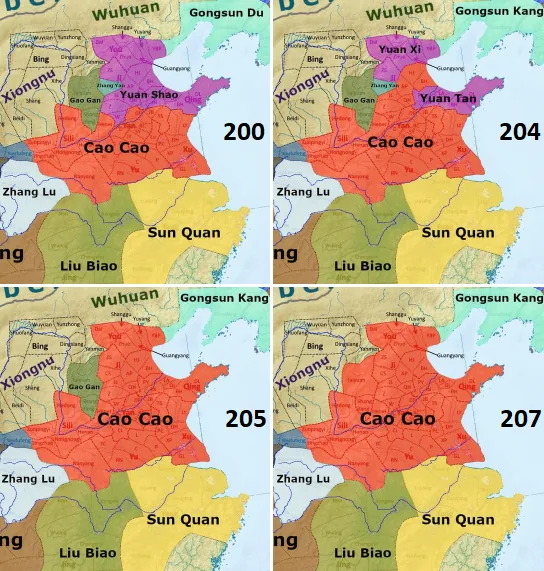
Wikimedia Commons · Creative Commons Attribution-Share Alike 4.0 International · file After pacifying northern China, Cao Cao returned to Ye and prepared troops for naval warfare at Xuanwu Pool. Coordinates represent the Ye/Handan area.
Southern campaign reaches Xinye
· Xinye County, Henan, China
Cao Cao's southern campaign reached Xinye, prompting Liu Cong's surrender and opening Jing Province to his forces. The source dates this to late September or October 208.
Naval drill at Qiao County
· Qiao County (present-day Bozhou, Anhui, China)
Cao Cao returned to his home county in spring 209, where he ordered boats built and staged a naval drill. Coordinates represent modern Bozhou.
Retreat through Huarong Trail
· Huarong Trail (near Jianli County, Hubei, China)
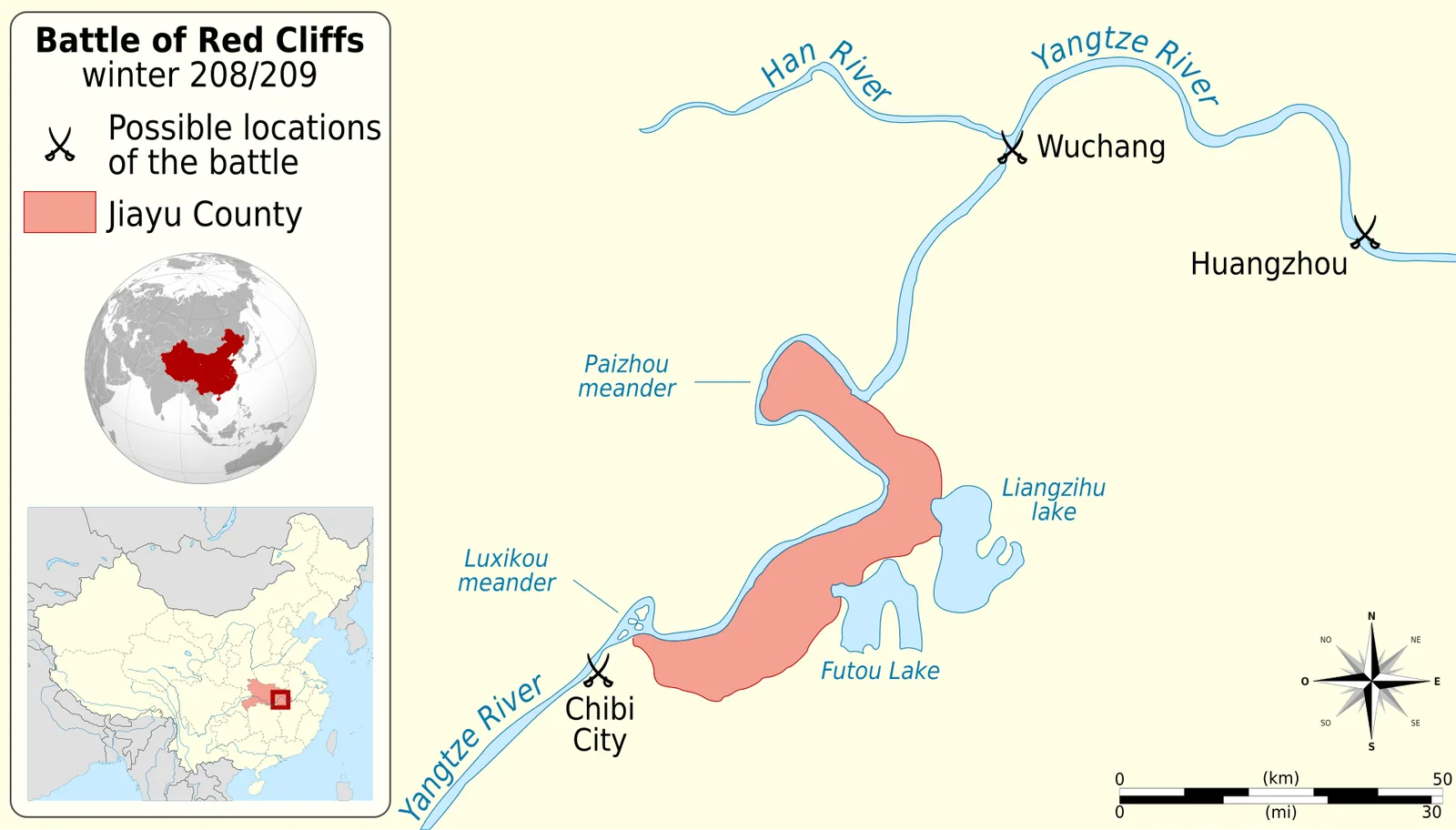
Wikimedia Commons · Creative Commons Attribution-Share Alike 3.0 Unported · file After Red Cliffs, Cao Cao personally led the surviving force through the difficult Huarong Trail during the retreat. The retreat followed the winter 208 battle; the card uses 209 because the source frames the battle as late December 208 or January 209.
Visit to Hefei garrison
· Hefei, Anhui, China
In autumn 209, Cao Cao sailed along the Huai River to the garrison at Hefei and issued relief orders for soldiers' families. Coordinates represent modern Hefei.
Battle of Tong Pass
· Tong Pass, Tongguan County, Shaanxi, China
Cao Cao personally campaigned against the Guanxi coalition, fighting around Tong Pass and the Wei River. The campaign ran approximately April–November 211; coordinates represent Tong Pass.
Return to Ye after Tong Pass
· Ye (present-day Handan area, Hebei, China)
After receiving Yang Qiu's surrender, Cao Cao returned to Ye late in 211. Coordinates represent the Ye/Handan area.
Campaign at Ruxu
· Ruxu, Anhui, China
Cao Cao led an army against Sun Quan at Ruxu on the Yangtze; neither side gained a decisive result. Coordinates are representative for the historical Ruxu/Ruxukou area east of Lake Chaohu.
Campaign at Yangping Pass
· Yangping Pass, Ningqiang County, Shaanxi, China
Cao Cao's army reached Yangping Pass during his campaign against Zhang Lu in Hanzhong Commandery. Coordinates are representative for Yangping Pass in the mountainous Ningqiang area.
Occupation of Nanzheng
· Nanzheng, Hanzhong, Shaanxi, China
After Yangping Pass was taken, Cao Cao occupied Nanzheng, the capital of Hanzhong Commandery. Coordinates represent Nanzheng District in modern Hanzhong.
Campaign reaches Juchao
· Juchao (present-day Chaohu, Anhui, China)
After a military drill at Ye, Cao Cao launched another campaign against Sun Quan and arrived at Juchao. The source dates his arrival to spring 217; coordinates represent modern Chaohu.
Hanzhong campaign reaches Chang'an
· Chang'an (present-day Xi'an, Shaanxi, China)
Cao Cao staged a military drill and began a campaign against Liu Bei; his army reached Chang'an in October. The preceding sentence identifies Cao Cao as launching the campaign; coordinates represent central modern Xi'an.
Advance through Xie Valley toward Hanzhong
· Xie Valley, Shaanxi, China
Cao Cao personally led his forces from Yangping Pass through Xie Valley toward Hanzhong before withdrawing to Chang'an. Coordinates are a representative point for the historically extensive Xie Valley route.
Arrival in Luoyang after Hanzhong campaign
· Luoyang, Henan, China
After returning from the Hanzhong campaign, Cao Cao arrived in Luoyang early in winter 219 and prepared to relieve Fancheng.
Death at Luoyang
· Luoyang, Henan, China
Cao Cao died at Luoyang and was posthumously titled King Wu by Emperor Xian. Coordinates represent modern Luoyang; the specific place of death is not identified in the source.